06/05/2026

NCP focuses on reforms, employment, investment in shadow budget
Staff Correspondent | Published: 2026-06-05 21:47:16
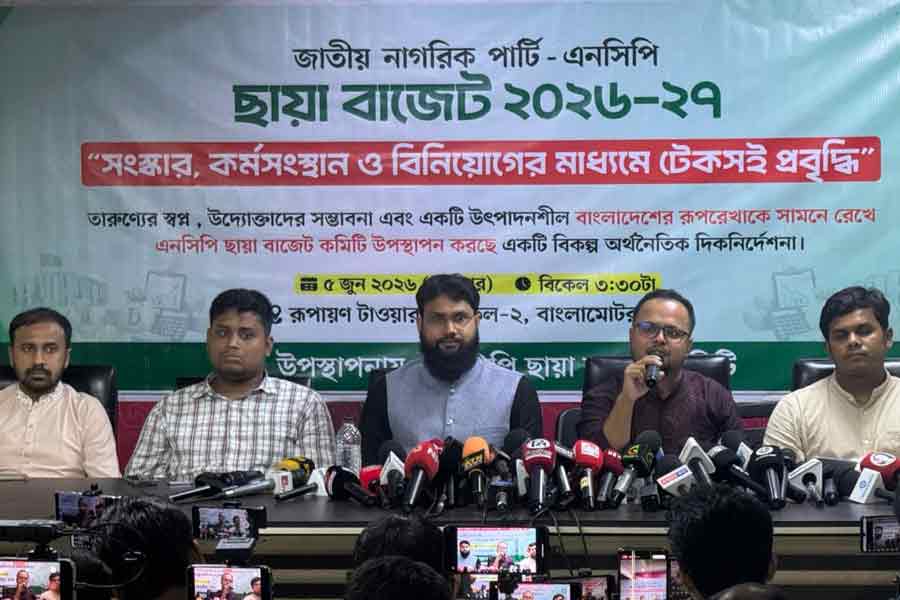
The National Citizen Party (NCP) has presented a shadow budget for the 2026–27 fiscal year titled “Bangladesh 2.0: Sustainable Growth through Reform, Employment and Investment”, outlining an alternative economic roadmap focused on welfare expansion, inflation control, job creation, and investment growth.
The announcement was made on Friday afternoon at a press conference held at the party’s temporary central office in Banglamotor, Dhaka.
The shadow budget was presented by the party’s Chief Organiser for the southern region and Member of Parliament Hasnat Abdullah. Senior leaders, including Joint Convener and MP Dr Atiq Mujahid, were also present.
NCP leaders said the proposed budget totals Tk8,52,157 crore, which is Tk62,157 crore higher than the current fiscal year.
They said the deficit has been kept within 3.09% of GDP, while inflation is targeted to be reduced from 9.2% to 8% in the coming fiscal year and further down to 6% in the following year.
The party also proposed increasing the tax-to-GDP ratio from 6.7% to 9.32% in the first year. To achieve this, it suggested mandatory income tax return submission linked with electricity connections, integration of TIN, NID, bank accounts and mobile financial services, introduction of wealth tax, digitalisation of ports, and removal of unnecessary tax exemptions. According to their estimates, these measures could generate an additional Tk76,000 crore in revenue.
The shadow budget also proposes significant reforms in the tax structure. It recommends raising the tax-free income threshold from Tk350,000 to Tk450,000, Tk475,000 for women and senior citizens, and Tk500,000 for persons with disabilities. It also suggests recognising zakat as a tax rebate, introducing inheritance tax, and reducing corporate tax from 27.5% to 25%.
In education and employment, the NCP proposed the largest allocation of Tk124,425 crore. The plan includes a school feeding programme in all government primary schools, a Tk5,000 crore teacher development fund, and the nationalisation of 5,000 schools. It also aims to create 10 million jobs over five years through SME loans, youth entrepreneurship funds, and digital training programmes.
In the health sector, the party proposed increasing the budget by 25% to Tk52,338 crore. Plans include introducing national health insurance, providing up to 70% subsidy for treatment of chronic diseases, establishing international-standard super-specialty hospitals in Mymensingh and Barishal, and deploying 500 GPS-tracked ambulances.
For agriculture, the proposals include modern crop marketing centres, direct subsidy transfers to farmers’ accounts, and expanded food storage infrastructure, along with continued food security programmes.
In renewable energy and environment, the party proposed a “Solar Energy Sovereignty Act,” including zero tax on solar products for five years.
It also outlined a Tk6,000 crore renewable energy programme to generate 2,000 megawatts of solar power within a year, establish 3,000 off-grid solar mini-grids in rural areas, and convert 50,000 diesel irrigation pumps to solar energy.
On women’s and youth development, the proposal includes a Tk5,000 crore women entrepreneurs’ fund, zero VAT on sanitary napkins, six months of paid maternity leave, and one month of paternity leave. It also suggested bringing imams, muezzins, caretakers, and priests under a government salary structure.
For the banking sector, the shadow budget calls for strict laws against loan defaulters, the creation of a state-run “bad bank,” public disclosure of all scheduled banks’ financial conditions, and raising the capital market size to 40% of GDP.
Additional proposals include increasing defence spending, developing domestic drone and missile technology, launching a real-time government expenditure tracking portal, imposing special taxes on undisclosed wealth, and establishing an independent budget office.
NCP leaders said their 71-point reform agenda is not merely an alternative budget but a comprehensive roadmap for building a corruption-free, equitable, and investment-friendly “Bangladesh 2.0.”
Editor & Publisher : Md. Motiur Rahman
Pritam-Zaman Tower, Level 03, Suite No: 401/A, 37/2 Bir Protik Gazi Dastagir Road, Purana Palton, Dhaka-1000
Cell : (+88) 01706 666 716, (+88) 01711 145 898, Phone: +88 02-41051180-81