NBR targets addt'l Tk 150bn in revenue from tobacco sector
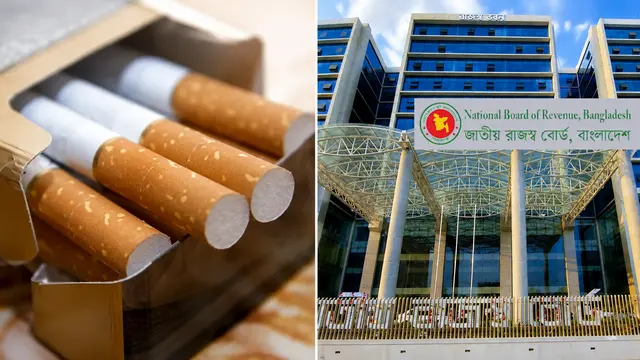
Technology-driven monitoring, higher price tiers and tighter oversight planned to curb tax evasion
The National Board of Revenue (NBR) has set an ambitious target of collecting Tk 6.04 trillion in revenue in the 2026-27 fiscal year, as the government seeks to raise Tk 9.38 trillion under the national budget.
To meet the target without increasing the tax burden on ordinary consumers, the revenue authority is turning its attention to high-potential sectors, particularly tobacco, from which it expects to generate more than Tk 150 billion in additional revenue.
Under its Budget Implementation Plan (BIP), the NBR has drawn up a five-pronged strategy for boosting revenue from the tobacco industry. The plan includes introducing a technology-based track-and-trace system, preventing illegal production and marketing, increasing the price tiers of tobacco products, and strengthening monitoring of tobacco-leaf processing and distribution.
According to NBR officials, around Tk 50 billion in additional revenue could be generated by introducing track-and-trace technology and curbing illicit production and sales. Another Tk 100 billion is expected from increasing the price tiers of tobacco products, while tighter monitoring of tobacco-leaf processing and distribution could contribute an additional Tk 6 billion.
The authority also plans to strengthen surveillance at different stages of production, supply and marketing to reduce opportunities for revenue leakage and tax evasion.
The government currently collects around Tk 400 billion annually from the tobacco sector. NBR officials believe the amount could be significantly increased through more effective monitoring of production and supply chains.
The renewed focus comes as the revenue authority has repeatedly struggled to meet its overall revenue targets in recent years and is now seeking to maximise collections from sectors with substantial revenue potential.
Technology to Tighten Tobacco Monitoring
As part of the strategy, the NBR plans to introduce a track-and-trace system to closely monitor the production and supply of tobacco products.
Counting devices and advanced artificial intelligence-powered cameras will be installed at factories to enable automated and centralised monitoring of production activities. The authority also plans to introduce QR and AR codes on cigarette stamps.
The system is expected to make it possible to trace tobacco products throughout the supply chain, from production to final marketing.
The NBR is also planning to develop a dedicated mobile application to help identify illegal cigarette and tobacco production and sales. Through the application, members of the public will be able to report suspected illegal tobacco products and activities to the revenue authority.
The authority is also considering introducing a reward mechanism for whistleblowers who provide information leading to the detection of illicit production or marketing.
Increasing the price tiers of tobacco products has been identified as another major source of additional revenue. The NBR expects to collect around Tk 100 billion through the measure.
At the same time, regular monitoring of tobacco-leaf processing and distribution is expected to generate another Tk 6 billion. The authority also plans to collect and verify information at different stages of production, processing, supply and marketing to minimise opportunities for tax evasion.
Hamidul Islam Hillol, a tobacco-control researcher and project director of the Bangladesh Network for Tobacco Tax Policy (BNTTP), said the move towards digital monitoring was a positive development.
“Cigarette taxes were previously collected through traditional methods. The system is now becoming digital, which is a positive step,” he said.
He noted that tobacco companies had various opportunities to evade taxes, including selling old stock at new prices and manipulating prices.
“Ensuring accountability of tobacco companies is essential,” he added.
Broader Revenue Mobilisation Plan
Alongside the tobacco sector, the NBR has adopted a range of measures to increase overall revenue collection during the current fiscal year.
Of the total revenue target of Tk 604,000 crore, the income tax wing has been assigned a target of Tk 223,480 crore, the VAT wing Tk 223,480 crore and the customs wing Tk 157,040 crore.
Under its revenue mobilisation plan, the NBR expects to collect an additional Tk 14,000 crore from outstanding revenues, Tk 8,400 crore through the settlement of pending cases and Tk 15,000 crore by improving the implementation rate of the Annual Development Programme (ADP).
It also expects to generate another Tk 15,000 crore by maintaining a 10% organic growth in revenue, while compliance-related measures and efforts to reduce revenue gaps are projected to contribute an additional Tk 8,950 crore.
The NBR plans to expand the tax net by bringing potential taxpayers at the upazila level under direct and indirect taxation. It also intends to increase public awareness of income tax and VAT and strengthen digital information-sharing with other government agencies to identify tax evasion. High-risk taxpayers will be identified and subjected to increased scrutiny.
At the field level, VAT commissionerates will conduct surveys to identify and register new businesses, with an expected additional revenue collection of around Tk 500 crore.
Another Tk 500 crore is expected by monitoring businesses that currently pay between zero and Tk 5,000 in VAT, while the preparation of accurate tariff-value-based declarations is expected to generate an additional Tk 400 crore.
The NBR has also set a target of collecting around Tk 10,000 crore in additional revenue from high-risk taxpayer entities and other sectors.
The authority is further updating information on withholding-tax deductors, including their addresses and the names and telephone numbers of their chief executives. It expects to collect another Tk 1,000 crore from this segment by June 30, 2027.
Revenue Target Seen as Challenging
Economists and analysts, however, believe that achieving the NBR's ambitious revenue target will be difficult under the current economic circumstances.
In the 2025-26 fiscal year, the revenue target was Tk 503,000 crore, against which the NBR collected Tk 415,473 crore, leaving a shortfall of Tk 87,527 crore, or around 17.4% of the target.
The Centre for Policy Dialogue (CPD), a private research organisation, has projected that revenue collection could fall Tk 130,000-140,000 crore short of the target in the current fiscal year.
Such a shortfall could increase pressure to cut public expenditure, particularly allocations under the Annual Development Programme.
Dr M A Razzaque, economist and chairman of Research and Policy Integration for Development (RAPID), said the revenue shortfall could still approach Tk 100,000 crore even under an exceptionally strong revenue performance.
“Every year, the government sets ambitious revenue targets in the budget. But given the NBR's past performance, achieving those targets in full has proved difficult,” he said.
Dr Mahfuz Kabir, economist and research director at the Bangladesh Institute of International and Strategic Studies (BIISS), stressed the need for continuity in revenue mobilisation efforts.
He said strict measures against tax evasion should be accompanied by safeguards to ensure that enforcement does not become a tool for harassment.
He also emphasised expanding the tax base through higher business activity and investment, alongside greater use of automation.
At a recent revenue conference, NBR Acting Chairman Ahsan Habib said revenue collection would need to grow by nearly 45% to meet the target for the current fiscal year.
However, he stressed that the target should be achieved without increasing the tax burden on consumers.
According to him, withholding income tax would be a key driver of income-tax collection. The NBR would focus on preventing tax evasion and taking other measures to meet the income-tax target.
For VAT, the authority plans to expand the VAT net, prevent evasion and identify regular taxpayers. In customs, efforts will focus on proper assessment, faster clearance of goods and recovery of outstanding revenues.
The NBR also plans to review the performance of its officials on a quarterly basis, including non-performance, and take action where necessary.
To raise taxpayer awareness, the authority intends to organise meetings, seminars and workshops throughout the year and strengthen engagement with institutions that are important sources of revenue.
It has also planned to audit 600 VAT-paying businesses by August 31 and settle refund claims of eligible businesses within the prescribed timeframe.
An NBR official said tobacco remained one of the country's major sources of revenue and therefore naturally carried high expectations.
“The aim is to achieve the revenue target without putting additional pressure on ordinary consumers,” the official said.
The NBR expects technology-driven monitoring, stronger enforcement and measures to prevent tax evasion to significantly increase revenue from the tobacco sector while strengthening the overall tax collection system.
Shamiur Rahman