Humanitarian actors demand a localized response and a safe repatriation roadmap
World Refugee Day 2026 calls for dignity and honor for Rohingya and host communities
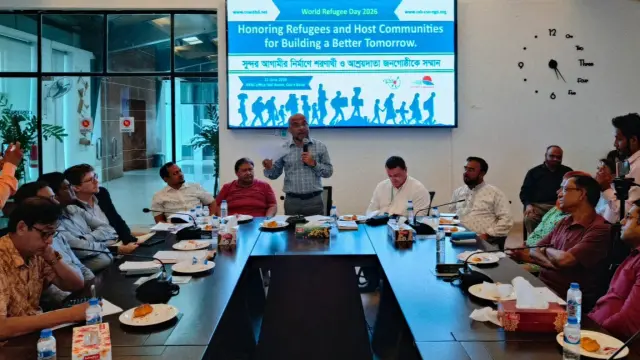
local stakeholders expressed concern that Local NGOs have been largely excluded from the implementation framework of the JRP 2026, a low-cost mechanism
Md. Shahinur Islam & Md. Jahangir Alam
Bangladesh is currently hosting approximately 1.6 million Rohingya refugees. Since the mass influx in 2017, the Government of Bangladesh, local communities, national and international NGOs, and UN agencies have provided critical humanitarian assistance. However, with humanitarian funding steadily declining, stakeholders emphasized the need for a more cost-effective and locally led response.
The 2026 Joint Response Plan (JRP) seeks US$710.5 million to support Rohingya refugees and host communities in Cox’s Bazar and Bhasan Char. As of June 2026, only US$368.3 million has been received, leaving the appeal less than half funded.
Against this backdrop, local stakeholders expressed concern that Local NGOs have been largely excluded from the implementation framework of the JRP 2026, a low-cost mechanism.
These concerns were raised at a seminar organized by the Cox’s Bazar CSO NGO Forum (CCNF) and COAST Foundation at the Office of the Refugee Relief and Repatriation Commissioner (RRRC) in Cox’s Bazar today.
Speakers noted that the current response structure does not adequately reflect the principles of the UN Humanitarian Reset, which calls for humanitarian action to be locally led and globally supported, with stronger partnerships and a 70% increase in pooled funding for local and national actors. But it did not happen in recent UN OCHA’s US$150 million funding.
The overwhelming majority, 92%, went to UN agencies and 8% to international NGOs, while local actors received no direct support. Participants also called for a “JRP 2.0” framework that would complement humanitarian assistance with a clear roadmap for the safe, voluntary, and dignified repatriation of Rohingya refugees to Myanmar.
Md. Iqbal Uddin of COAST Foundation presented the keynote and the seminar was moderated by CCNF General Secretary Md. Jahangir Alam.
In his keynote speech, Md. Iqbal Uddin called for revising the definition of Local NGOs in the Rohingya response to recognize organizations originating from Cox’s Bazar and led by local people.
He urged a more inclusive JRP process with meaningful participation from local government institutions, the District Administration, and the RRRC.
Distinguished speakers included Mohammed Mizanur Rahman, Refugee Relief and Repatriation Commissioner (RRRC); David Bugden, Head of the Rohingya Coordination Platform; Marcel Grogan, Head of Strategic Oversight Service at UNHCR; Marjina Akter, Vice Chairman of Teknaf Upazila; Kalim Ullah of Bangladesh Paribesh Andolon; former Palongkhali Union Parishad Chairman Mozaffar Ahmed; Saiful Islam Chowdhury Kalim of PULSE Bangladesh; Helal Uddin, Member of Rajapalong Union Parishad; Imam Khair of CBN News; Syed Md. Anwar, President of Ukhiya Press Club; Omour Faruk, General Secretary of NCP; journalist Abdus Sukur Rana of Prothom Alo; Rajapalong Union Parishad Chairman Mir Kashem; Nilima Akter Chowdhury of Agrajatra Bangladesh; journalist Nurul Islam; Abul Kashem of Help Cox’s Bazar; Advocate Hasan Siddiqui, President of Teknaf Upazila BNP; and Mahabubur Rahman, President of Cox’s Bazar Press Club.
Mizanur Rahman noted that migration from Rakhine State to Cox’s Bazar has a long history and stressed the need to address groundwater depletion by exploring alternatives to deep tubewells.
David Bugden acknowledged the sacrifices of host communities in sheltering Rohingya refugees and emphasized the importance of international diplomacy to support repatriation efforts.
Marcel Grogan called for strengthening peaceful coexistence between Rohingya and host communities while pursuing safe and dignified repatriation through coordinated national and international efforts.
Former UP Chairman Mozaffar Ahmed urged the distribution of treated Naf River water as an alternative water source.
Marjina Akter highlighted the need to curb drug trafficking and arms dealing in the camps and strengthen security measures.
Kalim Ullah called for environmental restoration initiatives in Teknaf and Ukhiya, while Advocate Saki Kawser emphasized peaceful coexistence and improved law and order.
Imam Khair urged increasing allocations for host communities, and Syed Md. Anwar advocated for greater engagement of Local NGOs in project implementation.
Several speakers, including Omour Faruk, Advocate Hasan Siddique, and Mahabubur Rahman, reiterated the demand for safe, voluntary, and dignified Rohingya repatriation.
Shamiur Rahman