
- International /
- Trump hails capture of Maduro as US vows legal 'wrath'

Int'l Correspondent
Published:2026-01-03 21:11:39 BdST
Trump hails capture of Maduro as US vows legal 'wrath'
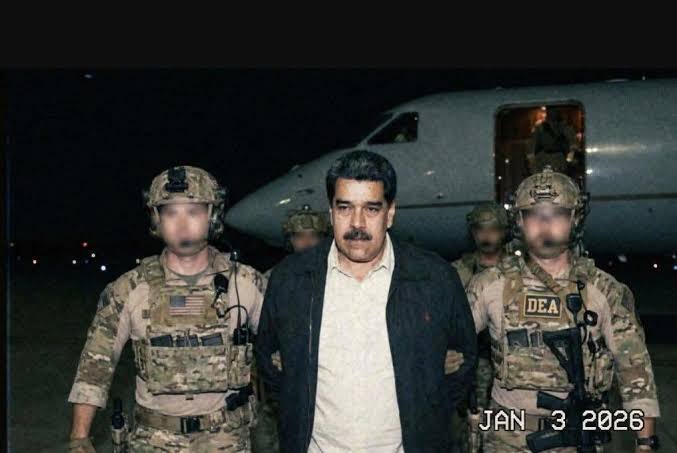
President Donald Trump on Saturday hailed the capture by the US military of Nicolas Maduro, as his attorney general vowed the Venezuelan leader would face the "full wrath" of American justice.
Maduro and his wife both face drug and terrorism charges in the United States, which has waged a months-long pressure campaign against the leftist president.
Maduro's capture marks end of 30-year socialist era, reshaping Venezuela's political landscape and Latin America's left-wing regimes.
In a stunning denouement, the US army's elite Delta Force snatched the Maduros as bombs fell on Caracas, US media reported, with Trump set to give further details in a press conference at 11:00 am (1600 GMT).
"The United States of America has successfully carried out a large scale strike against Venezuela and its leader, President Nicolas Maduro, who has been, along with his wife, captured and flown out of the Country," Trump said on Truth Social.
"This operation was done in conjunction with US Law Enforcement," added Trump, who is at his Mar-a-Lago residence in Florida, near the end of a two-week Christmas and New Year's vacation.
In a brief phone interview with The New York Times, Trump said "it was a brilliant operation, actually."
"A lot of good planning and lot of great, great troops and great people," the paper quoted Trump as saying -- adding that he did not answer a question about whether he had sought congressional approval.
There was no confirmation from Venezuela's government of the fate of the leftist Maduro, in power since 2013.
His government accused the United States of an "extremely serious military aggression" which follows a months-long campaign of increasing military and economic pressure by Trump.
The Venezuelan government called it an "imperialist attack" and urged citizens to take to the streets.
What happened in Caraacas
US military's elite Delta Force reportedly took Maduro from the heart of the capital city and flew him out of the country. This US action is the first of its kind in South America since the Cold War era.
So far, the global community, barring Russia, has not particularly rallied behind the Communist leader who's been president of the South American nation since 2013 when he succeeded Hugo Chavez upon his death.
For years, the US government has viewed Maduro not as a leader but as a high-level criminal. US authorities have accused him of leading a drug-trafficking group known as the “Cartel of the Suns”.
The name comes from the sun-shaped stars that high-ranking Venezuelan military officers wear on their uniforms.
Prosecutors argue that Maduro used his power to flood the US with cocaine as a way to "undermine the health" of the American people.
The pressure reached a breaking point recently when the US doubled the bounty for Maduro's capture to a historic $50 million, following up on a 2020 indictment. Attorney General Pam Bondi said nearly seven tonnes of cocaine was linked directly to Maduro.
Because the US has not recognized Maduro as the legitimate president since 2019, they saw this military mission on Saturday as a “counternarcotics operation” rather than war.
US Attorney General Pam Bondi said Maduro and his wife Cilia Flores had been indicted in the Southern District of New York on charges including "Narco-Terrorism Conspiracy," conspiracy to import cocaine, and charges related to machineguns.
"They will soon face the full wrath of American justice on American soil in American courts," Bondi said on X.
Amid U.S. military's operation have captured Venezuelan President Nicholas Maduro, 64 years old, and transferred him abroad, the nearly 30-year rule of "Chavismo" (Chávezism) is assessed to have reached a historic turning point.
It is expected to have significant repercussions not only on Venezuela’s political situation but also on the landscape of left-wing regimes in Latin America.
The indictment against Maduro was lodged in 2020 while the indictment against his wife was not previously known. Trump's administration in August doubled a reward for information leading to his capture to $50 million, accusing him of leading the alleged "Cartel of the Suns" drug trafficking organization.
'The tyrant is gone'
The US military action was now complete with "no further action in Venezuela now that Maduro is in US custody," a senator quoted Secretary of State Marco Rubio as saying.
The strikes on Venezuela were designed to "protect and defend those executing the arrest warrant," said Mike Lee, a Republican initially critical of the operation, wrote on X.
Rubio meanwhile reposted a social media message from earlier this year in which he said Maduro was not the legitimate president of Venezuela following elections that international observers said were riddled with irregularities.
Rubio's number two hailed a "new dawn" for Venezuela. "The tyrant is gone. He will now -- finally -- face justice for his crimes," Deputy Secretary of State Christopher Landau wrote on X.
Trump has given differing arguments for his campaign against Venezuela, including the claim that the country is a major drug exporter to the United States and that Venezuela seized US oil interests.
The US president said in December "it would be smart for (Maduro)" to step down and has also said that the Venezuelan leader's "days are numbered."
But the Maduro capture -- along with US strikes on Nigeria on Christmas Day -- also come despite Trump billing himself as a "peace president" who should win the Nobel Prize.
Asked by reporters on New Year's Eve what his resolution for 2026 was, Trump replied: "Peace on Earth."
Trump's claim of Maduro's capture comes just two days after the Venezuelan attempted renewed engagement, offering cooperation on fighting drug trafficking and illegal migration.
The capture of Maduro came -- coincidentally or not -- on the anniversary of Panamanian leader Manuel Noriega's surrender to US forces on January 3, 1990. Noriega was then tried and jailed in the United States.
It also comes on the anniversary of a US strike that killed Iranian Revolutionary Guards commander Qasem Soleimani on January 3, 2020, in Baghdad.
Unauthorized use or reproduction of The Finance Today content for commercial purposes is strictly prohibited.