
- National /
- End of the epic struggle

Shahin Abdul Bari & Samiur Rahman Lipu
Published:2025-12-31 00:42:57 BdST
Entire nation mourns the farewell of a bright star of politicsEnd of the epic struggle
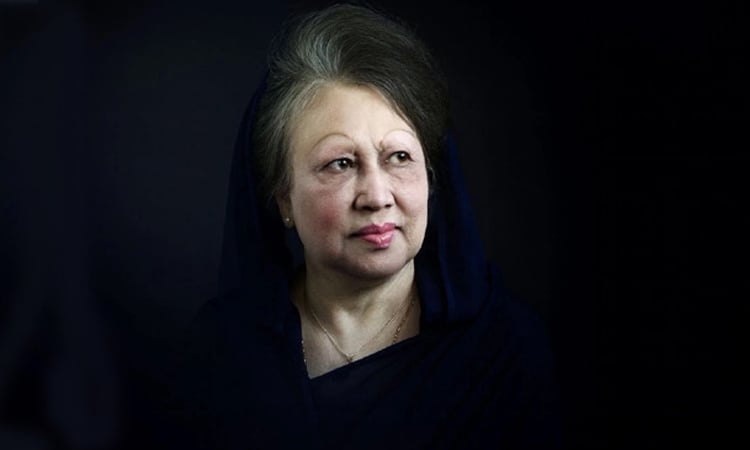
Bangladesh's political history is facing a deep void today. Everyone's beloved national leader, three-time elected former Prime Minister, the bearer and bearer of democracy, and one of the main symbols of the trust of the people of Bangladesh, BNP Chairperson and former Prime Minister Khaleda Zia is no more (Inna Lillahi wa Inna Ilaihi Rajiun). She was 80 years old at the time of her death.
Khaleda Zia, who became the undisputed leader in the history of Bangladeshi politics by thwarting the efforts of many experienced doctors, both domestic and foreign, and who was awarded the titles of 'Leader of the Nation' and 'Uncompromising' by the people, bid farewell to her beloved countrymen today.
The news of Khaleda Zia's death was confirmed by her personal physician and BNP National Standing Committee member Professor Dr. AZM Zahid Hossain.
He said, BNP Chairperson and former Prime Minister Begum Khaleda Zia passed away at 6 am on Tuesday, just after dawn.
Tarique Rahman by his mother's side in the last moments
Former Prime Minister and BNP Chairperson Begum Khaleda Zia was accompanied by her eldest son and BNP acting chairman Tarique Rahman during her final moments of death at Evercare Hospital.
Tarique Rahman's wife Dr. Zubaida Rahman, daughter Zaima Rahman, late Arafat Rahman's wife Shamila Rahman Sinthi, Begum Zia's younger brother Shamim Eskandar and his wife, elder sister Selina Islam and other family members were also present at the time.
In addition, BNP Secretary General Mirza Fakhrul Islam Alamgir and all members of the medical board involved in Khaleda Zia's treatment were present at the time of her death.
BNP Standing Committee member Salahuddin Ahmed told reporters at around 7:15 am on Tuesday that BNP Acting Chairman Tarique Rahman called him at around 6:30 am and said in an emotional voice, 'My mother is no more.'
Earlier, BNP media cell member Atiqur Rahman Rumon said that Khaleda Zia died at around 6 am while undergoing treatment at the capital's Evercare Hospital. BNP acting chairman Tarique Rahman and other family members are at the capital's Evercare Hospital.
He further said, "We are saddened by the untimely demise of Begum Khaleda Zia. We pray for the eternal peace of Begum Zia's soul and request everyone to pray for her departed soul."
Khatib of Baitul Mukarram to lead Khaleda Zia's funeral prayer
Mufti Abdul Malek, Khatib of the National Mosque Baitul Mukarram, will lead the funeral prayer of Begum Khaleda Zia. BNP Secretary General Mirza Fakhrul Islam Alamgir confirmed this to the media.
He said that Khaleda Zia's funeral prayers will be held at 2 pm tomorrow, Wednesday, at the South Plaza ground of the National Parliament Building and the entire area, including the adjacent Manik Mia Avenue.
BNP Standing Committee member Nazrul Islam Khan will conduct the entire funeral of Khaleda Zia. After the funeral, Begum Khaleda Zia will be buried next to her husband, martyred President Ziaur Rahman.
Helpless surrender to old age after struggling
Begum Khaleda Zia had been suffering from various physical problems, including heart disease, diabetes, arthritis, liver cirrhosis, and kidney complications, for a long time.
After being acquitted of all false and politically vendetta cases following the fall of the autocratic Sheikh Hasina government in July uprising on August 5, Begum Khaleda Zia was taken to London on January 7 this year. There, she was given advanced medical treatment. Her health also improved significantly.
She had become weak after enduring various health challenges, both physically and mentally. Age was also against him. She often fell seriously ill and was quickly admitted to the hospital.
At one such stage on November 23, Begum Khaleda Zia was admitted to the capital's Evercare Hospital for the last time after experiencing breathing difficulties. She was undergoing treatment under the supervision of a medical board comprising local and foreign specialist doctors.
She was undergoing treatment there for a little over a month. This time she could no longer respond to treatment. Having thwarted all the doctors' efforts, she crossed over to the other side.
Begum Khaleda Zia left BNP leaders, activists, supporters, followers and the general public of the country to tears during her farewell. After the news of her death was released, a mourning atmosphere was created in the hospital premises and the surrounding areas.
Colorful political life
Begum Khaleda Zia's political life was full of struggle. Despite imprisonment, illness and political adversities, she never remained silent in her demand for leadership. Her life proves that politics is not just about power, it is about ideals, faith and sacrifice.
Begum Khaleda Zia is the Chairperson of the Bangladesh Nationalist Party (BNP), who has served as Prime Minister of Bangladesh three times since 1991. She is the country's first female Prime Minister and the second elected female head of government in the Muslim world.
Begum Zia's long political career was not just a story of reaching the pinnacle of power; it was a unique example of adversity, sacrifice, political fortitude, and leadership.
Begum Zia holds a unique record in the country's politics. Her unique record in electoral history is that she contested 23 seats in five national elections and won all of them. She was elected from five different seats in the general elections from 1991 to 2001. She also won all three seats she contested in the 2008 elections.
Under her visionary leadership; parliamentary democracy was reintroduced in the country, which was an important milestone in the constitutional history of Bangladesh. As a Prime Minister, she took various initiatives in the education, health, agriculture, women's development and social security sectors. Her government's policies, especially in women's education and rural development, had a significant impact.
In 2001, Begum Khaleda Zia was elected Prime Minister for the third time and implemented various programs for the development of the country's infrastructure, poverty alleviation and economic reforms. At the same time, political rivalry, differences of opinion and controversy complicated her rule. Nevertheless, she remained a steadfast symbol of democracy and nationalism to her supporters.
She was born on 15 August 1945 in Dinajpur district to Iskander Majumdar and Taiba Majumdar. Her father migrated from Jalpaiguri, India to the then West Pakistan after the partition. Their original home was in Feni. She studied at Dinajpur Government Girls High School and later at Surendranath College. In 1960, she married Ziaur Rahman.
After Ziaur Rahman Bir Uttam became President, Begum Zia accompanied him on various state tours as First Lady. During this time, she met with leaders of various countries, including British Prime Minister Margaret Thatcher and Queen Juliana of the Netherlands.
From housewife to the top of power
The tragic assassination of President Ziaur Rahman in 1981 brought a profound change in Begum Khaleda Zia's life. Transforming personal grief into strength, she entered the difficult arena of politics.
It is worth noting that 44 years ago, President and BNP founder Ziaur Rahman was assassinated by a renegade group of army personnel. After President Ziaur Rahman was assassinated at the Circuit House in Chittagong on May 30, 1981, Khaleda Zia was staying in the Dhaka Cantonment with her two children.
At this critical moment of the country, BNP was in turmoil. Discussions were going on about who would take over the leadership of the party. In such a situation, Begum Khaleda Zia joined the BNP as a primary member on January 2, 1982.
With political wisdom and determination, she was quickly elected as the party's senior vice chairman. She was elected the acting chairperson of the party on January 12, 1984, and the chairperson unopposed on May 10 of the same year. Later, she became the chairperson three more times in 1993, 2009, and 2016's councils.
Begum Khaleda Zia faced various adversities since taking charge of the party. Keeping the party united, she built a movement against Ershad's dictatorship. She continued the movement in the interest of the country and the people without any compromise. This hastened Ershad's downfall.
She started a movement against autocratic Ershad in 1987 and as a result of a long struggle, BNP won a majority in the national parliamentary elections held on February 27, 1991.
Khaleda Zia became Prime Minister for the first time in 1991. She then became Prime Minister for the second time on February 15, 1996 and for the third time in 2001 through a coalition election. She also served as Chairperson of SAARC twice.
Uncompromising leadership despite arrest and torture
Begum Zia's role in the democratic movement against military rule in the 1980s was courageous and steadfast. Despite arrests, persecution and political pressures; she did not compromise. Her leadership was historically important in the 1990 mass movement that brought down the dictatorship and restored democracy.
She was arrested on November 28, 1983, May 3, 1984 and November 11, 1987 during the anti-Ershad movement.
She was also arrested during 1/11. She was arrested on September 3, 2007, during the military-backed caretaker government. After a long imprisonment, she was granted bail in all cases. Although attempts were made to send her abroad while she was in prison. But she did not leave the country.
After the Awami League came to power on November 13, 2010, she was evicted from her cantonment house. She had lived in this house for 28 years. After Ziaur Rahman was killed, the then President Abdus Sattar allotted the house in Begum Zia's name.
During the last Awami League government, 37 cases were filed against her. Since joining politics, she has become an uncompromising leader of the anti-dictatorship movement.
Despite intense pressure to leave the country, she did not budge from her position. In the last 15 years, she has faced various tortures and has also been in prison. Yet, Khaleda Zia did not compromise.
Begum Khaleda Zia's entire political journey has been a symbol of determination, uncompromisingness, and struggle. That’s why, she has become the name of unyielding struggle in the country's politics.
Her passing today marks the end of an era. Begum Khaleda Zia will be remembered in history as a courageous female leader who led despite difficult realities and set a strong example of women's empowerment in Bangladeshi politics. Her life and work will remain a source of inspiration for future generations.
Unauthorized use or reproduction of The Finance Today content for commercial purposes is strictly prohibited.