Crowd Drawn to Chinese Medical Treatment at BTM Fair
Seok Healthcare Makes a Splash in Medical Tourism
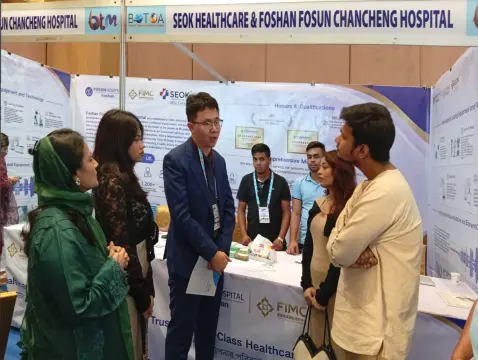
Seok Healthcare, one of the organisations working in the medical tourism sector, participated in the fair as a co-sponsor. The event was held from September 3 to 5 at Hotel InterContinental Dhaka
The Bangladesh Travel Mart (BTM) 2026, held recently in Dhaka, placed special emphasis on medical tourism alongside the country’s traditional tourism sector. For the first time, medical tourism emerged as a major attraction at the three-day travel fair, drawing considerable interest from visitors seeking information about advanced treatment options abroad.
Seok Healthcare, one of the organisations working in the medical tourism sector, participated in the fair as a co-sponsor. The event was held from September 3 to 5 at Hotel InterContinental Dhaka. A significant number of visitors gathered at the Seok Healthcare booth to learn about advanced Chinese medical services.
Patients and their relatives showed particular interest in treatment options for cancer and other complex diseases, second opinions, precision oncology, advanced radiotherapy and proton therapy. Many visitors sought information about the latest cancer treatment technologies available in China, as well as treatment costs, hospital facilities and the procedures involved in travelling abroad for medical care.
Chinese Delegation Takes Part
A delegation from China also participated in the fair. The delegation included Dr Zhu Wenzhong, Stella Chan, Bill Xu, Mushdak Hastis and other representatives from the healthcare sector.
They briefed visitors on the medical services, infrastructure and advanced technologies available at Foshan Fosun Chancheng Hospital in China.
MM Masumuzzaman, Chairman of Seok Healthcare said that families dealing with complex diseases such as cancer have to fight not only the disease itself but also uncertainty over where and how to obtain the right treatment.
He said patients and their families often need answers to several critical questions: whether the diagnosis is accurate, whether a second opinion is necessary, which specialist should be consulted, what type of treatment is required, how much the treatment may cost and which hospital would be appropriate and safe if treatment is sought abroad.
Against this backdrop, the organisation has taken an initiative to establish an integrated international medical assistance system for Bangladeshi patients, he added.
From Report Review to Follow-up
According to Seok Healthcare, its services are not limited to sending patients to overseas hospitals.
Initially, a patient's medical reports, pathology results, CT scans, MRI, PET-CT reports and previous treatment history are collected and reviewed before being forwarded to relevant specialists.
Where necessary, the organisation arranges virtual medical consultations and second opinions. Based on the specialists’ assessments, possible treatment options, suitable hospitals, treatment duration and other relevant matters are coordinated.
If overseas treatment is required, Seok Healthcare also provides assistance with visa processing, transportation, accommodation, language support, hospital appointments and treatment coordination. The organisation says it also assists patients with post-treatment follow-up after they return home.
Advanced Cancer Treatment in China
Foshan Fosun Chancheng Hospital places emphasis on multidisciplinary cancer care, alongside chemotherapy, targeted therapy, immunotherapy and advanced radiotherapy.
According to information provided by the hospital, its oncology services include technologies such as robotic surgery, precision radiotherapy, minimally invasive treatment, CAR-T cell therapy and PET/CT.
The hospital was established in 1958. According to information published by Fosun Health, it currently has 1,750 authorised beds and more than 2,800 doctors and healthcare professionals working across different departments. More than 3.1 million outpatient visits are reportedly recorded at the hospital annually.
Fosun Health also claims that from 2018 to 2025, the hospital ranked first for eight consecutive years in one of China’s leading rankings of private hospitals.
Particular Interest in Proton Therapy
Proton therapy emerged as one of the major attractions for visitors at the fair. Representatives said Foshan Fosun Chancheng Hospital offers proton therapy alongside advanced radiotherapy as part of its cancer treatment infrastructure.
Medical experts, however, emphasise that proton therapy and other advanced technologies are not appropriate for every patient. Treatment decisions should be based on factors including the type and location of the cancer, its stage, previous treatment, the patient’s age and overall physical condition.
The hospital’s cancer centre is also involved in precision oncology and radiotherapy research. A research paper published in 2026, involving physicians from Foshan Fosun Chancheng Hospital, discussed a case of recurrent ovarian cancer involving a combination of SCART-based radiotherapy and chemotherapy.
Dedicated Services for Int'l Patients
To facilitate treatment for international patients, Foshan Fosun Chancheng Hospital launched an International Medical Center in March 2026.
According to information about the facility, the 100-bed centre provides medical consultation, diagnostic testing, hospital admission, rehabilitation, medical visa assistance, multilingual services, insurance coordination and remote post-treatment follow-up.
According to data published by Fosun Health, its network of international hospitals collectively admitted more than 60,000 oncology patients in 2025. Several hospitals within its network provide precision radiotherapy, robotic surgery and other advanced cancer treatment technologies.
Growing Cancer Burden in Bangladesh
The growing demand for cancer treatment in Bangladesh has also increased the importance of international medical assistance.
According to GLOBOCAN 2022 data from the International Agency for Research on Cancer (IARC), Bangladesh recorded an estimated 167,256 new cancer cases in 2022, while 116,598 people died from cancer. The estimated number of people living with cancer or requiring treatment within a five-year period was around 346,000.
Among Bangladeshi men, cancers of the oesophagus, lip and oral cavity, and lung are significant. Among women, breast and cervical cancers are prominent, while oesophageal cancer also accounts for a considerable share.
Cost of Treatment Remains a Major Challenge
Cancer treatment can impose a substantial financial burden on families. A study on Bangladesh published in the International Journal for Equity in Health in 2025 found that the average annual out-of-pocket expenditure per cancer patient was approximately US$6,504.
The study also found that nearly 90 percent of the families surveyed experienced some form of financial hardship because of cancer treatment.
It further indicated that patients receiving treatment abroad incurred significantly higher average annual costs than those treated domestically. Therefore, experts say patients should have a clear understanding of the potential benefits, risks, duration and total cost of treatment before deciding to seek medical care overseas.
New Prospects for BD-China Healthcare Cooperation
Seok Healthcare said a Bangladeshi delegation, including representatives of the organisation, visited Guangzhou, China, in March 2026. During the visit, discussions were held on precision oncology, international patient management, referral systems and insurance support.
Later, Chinese healthcare institutions also showcased proton therapy and precision oncology services at an international medical equipment exhibition held in Dhaka.
Seok Healthcare claims that it has provided services to more than 4,000 patients over the past three years. The organisation says it is connected with more than 75 hospitals and institutions worldwide, while over 1,000 doctors from internationally recognised institutions are affiliated with its network.
According to sector insiders, the most important considerations for Bangladeshi patients seeking treatment abroad are accurate diagnosis, expert medical opinions, the necessity of a particular treatment, its potential benefits and risks, and a transparent assessment of the total cost.
Rather than choosing overseas treatment simply because a hospital offers advanced technology, experts recommend determining whether that particular technology is actually necessary and suitable for the individual patient.
The participation of Seok Healthcare and the presence of Chinese medical institutions at BTM 2026 signal new possibilities for healthcare cooperation between Bangladesh and China. However, the long-term success of such initiatives will depend on appropriate patient selection, transparency in treatment information, clear cost estimates and effective post-treatment follow-up after patients return to Bangladesh.
Shamiur Rahman