
- Economy /
- Finance Division rolls out BIPs to fix spending, curb rising debt burden

Staff Correspondent
Published:2026-01-24 21:55:17 BdST
Finance Division rolls out BIPs to fix spending, curb rising debt burden
The Finance Division has initiated the introduction of effective Budget Implementation Plans (BIPs) for ministries to ease mounting pressure from the government’s heavy domestic debt repayments, which are largely driven by weak coordination, inefficiencies in budget planning and monitoring, and unusually high expenditure concentrated in June.
According to officials, the government currently repays nearly Tk1 lakh crore in domestic debt every year. Lower revenue collection during the early months of the fiscal year often compels the government to resort to domestic borrowing, intensifying fiscal stress.
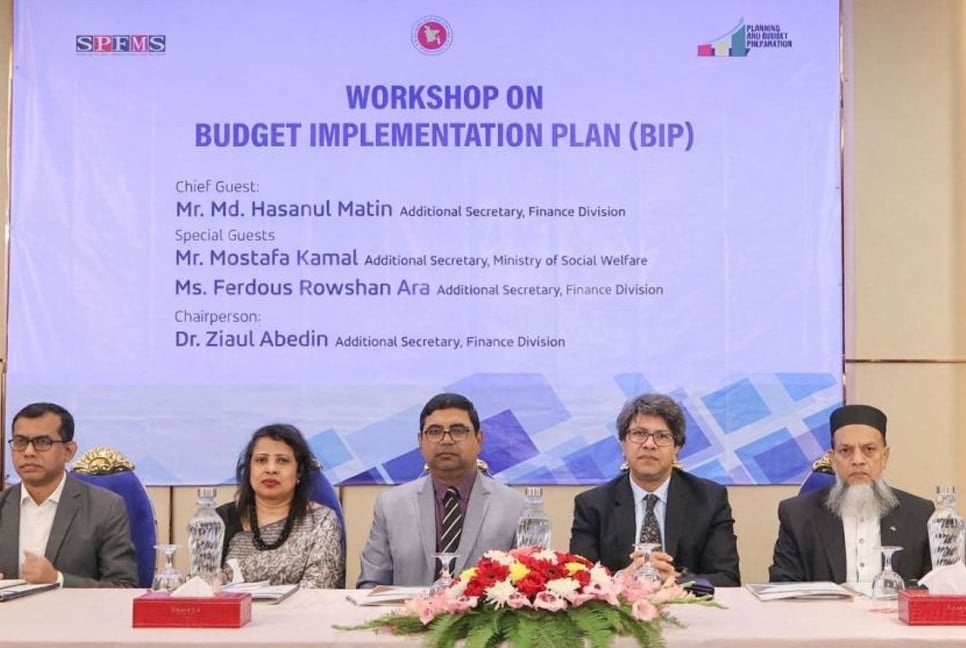
The initiative was discussed in a two-day workshop titled “Budget Implementation Plan” on 23–24 January at a hotel in Cox’s Bazar.
Senior officials from 18 ministries participated in the workshop, which was organised under the Scheme on Improving the Budget Process through Capacity Development of Budget Management Committees and Budget Working Groups of the Strengthening Public Financial Management Program to Enable Service Delivery (SPFMS), Finance Division (FD).
Officials at the workshop said budget execution will now begin from the very start of the fiscal year, allowing for more effective, timely and outcome-oriented implementation while ensuring the proper use of public funds.
Additional Secretary (Budget and Macroeconomics), FD, Md Hasanul Matin, attended the workshop as the chief guest. Additional Secretary, FD Ferdous Rawshan Ara and Additional Secretary, Ministry of Social Welfare Mostafa Kamal were present as special guests.
The workshop was chaired by Additional Secretary (Budget), FD, and National Programme Director of SPFMS Dr Ziaul Abedin. Joint Secretary Mohammad Faruk-uz-Zaman delivered the welcome address.
Speaking at the event, Md Hasanul Matin said there is a direct link between reducing abnormal government expenditure in June and the introduction of effective Budget Implementation Plans.
He stressed the importance of assessing whether budget allocations are being spent on priority and quality sectors.
Matin noted that excessive spending at the end of the fiscal year increases borrowing needs, while disciplined and evenly phased expenditure can significantly reduce domestic debt pressure and restore fiscal discipline.
Dr Ziaul Abedin said improving operational efficiency is critical for effective budget execution.
He pointed out that preparation of Budget Implementation Plans often consumes over the first quarter of the fiscal year, undermining their usefulness.
To be effective, the BIP process must begin much earlier and be aligned with budget approval timelines, he added.
Ferdous Rawshan Ara said that although the size of the national budget has expanded significantly over the years, implementation capacity has not increased at the same pace.
She described the BIP as a strategic framework that strengthens transparency, accountability and discipline in budget execution.
Mostafa Kamal said effective Budget Implementation Plans are essential to sustaining the country’s quality development trajectory and ensuring value for money in public spending.
The business session on the Significance of BIP for Effective Budget Execution was moderated by Mohammad Faruk-uz-Zaman, while Md Zakir Hossain, Deputy Secretary of the FD, delivered the presentation.
The session highlighted that BIPs translate annual budget allocations into time-bound, activity-based implementation roadmaps. By linking budgets with procurement plans, cash flow projections and quarterly expenditure targets, BIPs help prevent early delays and year-end spending rushes.
Participants noted that improved coordination among ministries and enhanced monitoring through systems such as iBAS++ would strengthen fiscal discipline, expenditure predictability and macro-fiscal stability.
A group session on “Experiences of BIP: Challenges and Way Forward” was moderated by Joint Secretary Md Nazrul Islam.
Participants were divided into four groups to identify implementation challenges and propose solutions.
Group-1
Group-1 identified delayed BIP issuance, system misalignment, capacity gaps, procedural bottlenecks and weak integration among APP, iBAS++, e-GP and related platforms as key obstacles.
This group recommended timely issuance of BIPs, stronger system integration, realistic planning, improved training and clearer coding practices.
Group-2
Group-2 highlighted capacity constraints, fragmented systems, frequent staff transfers, delayed project approvals, land acquisition challenges and slow procurement as major impediments.
This group called for capacity building, realistic budgeting, simplified procedures and greater administrative and financial autonomy for ministries.
Group-3
Group-3 focused on policy perspectives and practical considerations related to BIP implementation, emphasising discussion-based analysis and interactive engagement rather than detailed technical presentations.
Group-4
Group-4 pointed to operational and system-related weaknesses in BIP entry and execution within iBAS++, including coding mismatches, weak linkage with procurement systems and delayed budget revisions.
This group stressed accurate coding, regular monitoring, timely corrections and stronger coordination led by the Finance Division.
Unauthorized use or reproduction of The Finance Today content for commercial purposes is strictly prohibited.