
- National /
- Legal advisers help migrants pose as gay to get asylum

Billy Kenber & Phil Kemp
Published:2026-04-16 01:45:27 BdST
BBC's undercover investigation into the immigration system: Part 2Legal advisers help migrants pose as gay to get asylum
A shadow industry of law firms and advisers is charging thousands of pounds to help migrants pretend to be gay in order to stay in the UK, the BBC has found.
In the first part of a major undercover investigation, we reveal how migrants whose visas are due to run out are being given fake cover stories and instructed in how to obtain fabricated evidence, including supporting letters, photographs and medical reports.
They then apply for asylum claiming to be gay and in fear for their lives if they return to Pakistan or Bangladesh.
In response to our findings, the Home Office said: "Anyone found trying to exploit the system will face the full force of the law, including removal from the UK."
The UK's asylum process offers protection to people who can't return to their home countries because they would be in danger, for example in countries like Pakistan and Bangladesh where gay sex is illegal.
But the BBC News investigation reveals the process is being systematically exploited by legal advisers extracting fees from migrants who want to stay in the country.
These are often people whose student, work or tourist visas have expired, rather than those who have just arrived in the country on small boats or through other illegal routes.
This group now makes up 35% of all asylum claims, which topped 100,000 in 2025.
After gathering initial evidence, including tip-offs, we sent undercover reporters to investigate how willing immigration advisers were to help people make up false asylum claims.
The reporters posed as international students from Pakistan and Bangladesh whose visas were due to expire.
The investigation discovered:
> One law firm charged up to £7,000 to bring a fabricated asylum claim and promised that the chance of refusal by the Home Office was "very low"
> Fake asylum seekers visited GPs pretending to be depressed in order to get medical evidence to bolster their cases, with one even lying about being HIV positive
> One immigration adviser boasted that she had spent more than 17 years helping bring fake claims and said she could arrange for someone to pretend they'd had a gay sexual relationship with a client
> Our undercover reporter was even told he could bring his wife over from Pakistan once he had got asylum in the UK and she could then make a fake claim pretending to be a lesbian
> A lawyer linked to another firm told an undercover reporter he had helped people pretend to be gay or atheists to successfully obtain asylum. He offered to help with a fake claim for a fee of £1,500 and said it would cost a further £2,000-£3,000 to create evidence
'Nobody is gay here'
On a Tuesday evening at a community centre in a quiet corner of Beckton, east London, more than 175 people have gathered for an event.
Some have travelled from as far as South Wales, Birmingham and Oxford to attend a meeting organised by Worcester LGBT, which describes itself as a support group for gay and lesbian asylum seekers.
The group's website says that only genuine gay asylum seekers are welcome.
But the men spilling out from the centre's doors onto the pavement outside readily admit to our undercover reporter that all is not as it seems.
"Most of the people here are not gays," one man called Fahar says.
Another, who gives the name Zeeshan, goes further.
"Nobody is a gay here. Not even 1% are gay. Not even 0.01% are gay."
Our undercover reporter's journey to the group's meeting began in late February when he approached Mazedul Hasan Shakil, a paralegal at Law & Justice Solicitors, an immigration law firm based in Birmingham and London.
As well as his legal work, Shakil is also the founder and chairman of Worcester LGBT. Until recently, he used the community group's website to advertise his legal work.
During a brief phone call, Shakil told the undercover reporter he had to be fearing persecution to claim asylum and did not appear to have any grounds to do so.
But within a few hours, out of the blue, the reporter took a phone call from someone introducing herself as Tanisa.
With the conversation having now switched to Urdu, she appeared much more enthusiastic about helping our reporter stay in the country, discussing how he could apply for asylum on the grounds that he's gay.
When he told her that he wasn't gay, she told him: "Listen to me. There is nobody who is real. There is only one way out in order to live here now and that is the very method everyone is adopting."
She would not be drawn on who had passed her his number, but we were able to match her WhatsApp profile picture and first name to Tanisa Khan, who works as an adviser to Worcester LGBT.
'A comprehensive package'
That evening the undercover reporter travelled to Forest Gate, in east London, for an initial consultation with Tanisa.
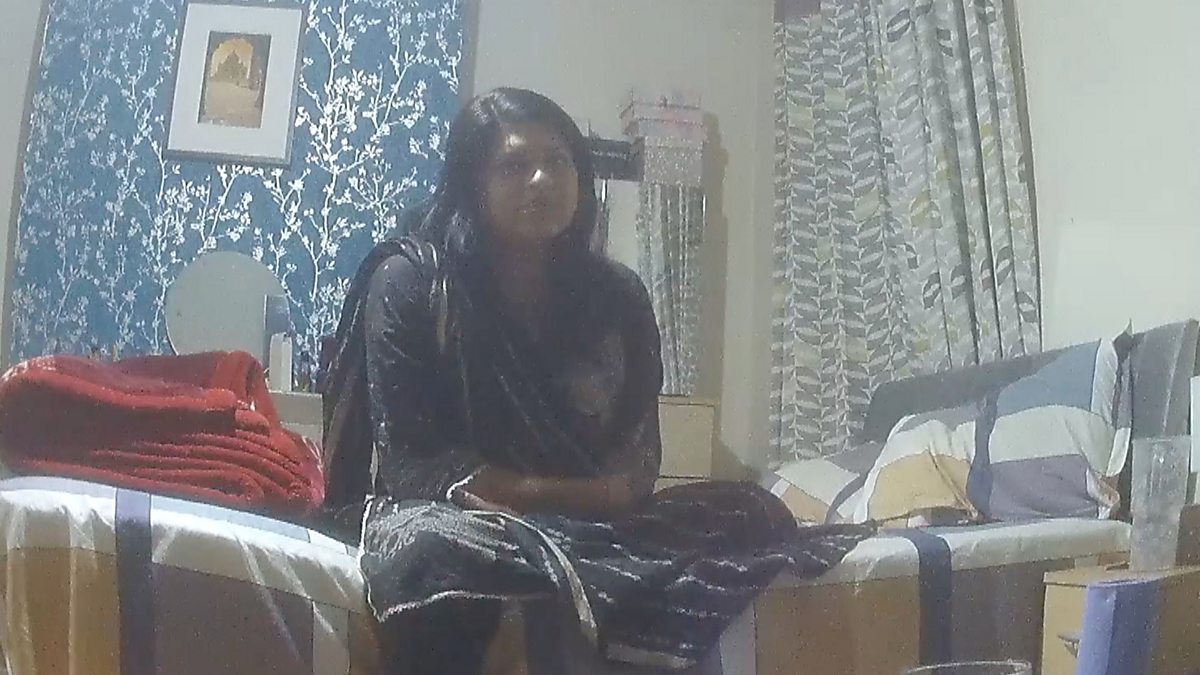
The first meeting took place not at the law firm offices she would later use, but at her own home. He was invited inside and taken upstairs to a bedroom.
"At the moment there is only one route from where you can get a visa and it is open," Tanisa explained, perched on the edge of the bed.
"It is the asylum visa...it is on human rights and it is called gay case or same sex. There is no hope for any other visa."
Tanisa stressed that what she was proposing would take work - as the reporter would have to memorise a made-up story for his interview with the Home Office.
"You are the one who has to go and take the exam. I am here to prepare everything for you but ultimately it is you who has to go there," she told him.
What followed over the course of 45 minutes in Tanisa's bedroom was an insight into how sophisticated the deception involved in some fake asylum claims can be - and therefore how difficult it can be for officials to spot it.
Undercover footage of an Asian woman sitting on a bed. The chimney breast behind her has been turned into a feature wall with bright blue and silver wallpaper, while the bed cover is a large check pattern in yellow, blue and grey.
Also Read: Bogus websites, staged protests and pretend atheists: Inside the fake asylum industry
Asylum seekers are subject to an initial screening interview with the Home Office and then an exhaustive "substantive interview" lasting several hours, during which their claims are probed.
Home Office decisions to reject an asylum applicant can be challenged, and potentially overturned, in the courts.
"There is no check-up to find out if the person is a gay," Tanisa told our undercover reporter.
"The main thing is what you say. You just have to tell them that 'I am a gay and it is my reality'.
"There are a lot of organisations here where there are people like you who are not gay but are applying for the visa. You are not alone," she reassured him.
She went on to explain how the deception would work.
"The approach we will take is this: I will fully prepare you for the interview by compiling a comprehensive package for you, including photographs of you at clubs, various other pieces of supporting evidence, an organisational letter, and additional letters of support, so that you are completely ready when I send you in."
Tanisa, who said she had spent more than 17 years helping bring fake claims, explained that photographs taken of our reporter at LGBT events and the tickets he would buy for them would serve as evidence as part of his application.
"I will give you a letter from someone along with which we will take a few photographs and that person will write that they have engaged in physical sex with you," she added.
Tanisa's service came at a price - £2,500 - with a warning that the cost would go up in the unlikely event that our reporter's claim was refused by the Home Office and it went to appeal through the courts.
A successful application would be worth the work involved, she explained.
"You can live here and work and you are also eligible to claim benefits."
But if his asylum claim was successful, what would that mean for his wife back in Pakistan, our reporter asked, if he had already told the Home Office he was gay?
"If you call her here, then we will apply for her asylum as well," Tanisa replied.
"Once she's here, we can make her a lesbian."
Providing evidence
Tanisa is not a regulated immigration adviser and as a result it is illegal for her to offer immigration advice.
She remained cagey about her connection to the paralegal we had called that morning, stating only that she worked with him.
"Lawyers and the like are supposed to show you the way. However, the actual fieldwork is something they do not handle," she explained, seemingly referring to the work of fabricating evidence.
"We handle the fieldwork."
But her links with Shakil became clearer during two subsequent meetings, both of which took place at the Ilford offices of Law & Justice, the law firm where Shakil works.
"I work with a lawyer, so I use his office," she explained.
During one meeting, our undercover reporter asked to be introduced to Shakil to thank him for introducing him to Tanisa and was led through to a neighbouring room where he shook Shakil's hand.
Tanisa also explained the role played by Worcester LGBT, which she described as "our organisation" and which claims on its website to have been "formally acknowledged by the Home Office...recognising our continued contribution to supporting LGBT+ asylum seekers across the UK".
She told the reporter he must attend the next meeting, held in early April, and told him some people there would be like him and pursuing fake cases and "there will be genuine ones, too".
"This meeting is essential because you are required to provide evidence to the Home Office demonstrating that, if you are gay, you are indeed affiliated with a gay organisation," she told him.
She said Worcester LGBT would be able to issue a letter he could use as evidence for his application.
"We will issue a letter from our end stating that you…are our member, the genuine one, affiliated with us, and someone we personally know. This type of evidence is very strong."
We showed our footage to Ana Gonzalez, an expert immigration lawyer with 30 years' experience. She said Tanisa was clearly breaking the law, "committing fraud by manufacturing a claim to give to this person".
"People like that [are] just really making things harder for the legitimate asylum seekers and refugees out there," Gonzalez said.
"Particularly for something that is as intangible as being LGBTI, really, because when you are a victim of torture, when certain things happen to you, often there is a way of evidencing that, in an objective way.
"When it comes to the queer community, it is not. It is just based on contact and on how you actually present and how convincing you can be on that particular day, irrespective of whether you're telling the truth or not."
After being approached by BBC News with her comments to the undercover reporter, Tanisa blamed communication difficulties for a "misunderstanding" and said she doesn't speak Urdu fluently. She denied advising the reporter to make a false claim or offering to create fabricated evidence.
Shakil said he passed on the undercover reporter's details to Tanisa without knowing or suspecting that she would offer to fabricate an asylum claim.
He said Worcester LGBT did not create or support fabricated evidence in asylum claims and it was not up to the organisation to determine whether any individual was actually gay.
Worcester LGBT was conducting an investigation into Tanisa's conduct and that she had no decision-making authority within the group, Shakil added.
Law & Justice Solicitors said Tanisa had no professional connection to the firm and that it was investigating "any potential unauthorised access" to its London office.
It said our undercover reporter was never set up as a client of the firm.
At the same time as he was meeting with Tanisa, our undercover reporter also made an appointment with an adviser at the law firm Connaught Law, which has its offices in the heart of London's legal district.
There he met Aqeel Abbasi, a senior legal adviser at Connaught.
Abbasi told our reporter that he could help him stay in the country and appeared to be willing to direct him on how to fabricate evidence for a fake claim
He promised that the chance of refusal by the Home Office was "very low".
He said his fee would be £7,000 and, once that had been paid, his office would contact the undercover reporter to guide them through the process and the kind of evidence required.
This would include advising him on "where to go or what specific actions to take".
"Evidence must be provided and submitted from their societies and clubs," Abbasi said.
"Where they go, where their gay clubs are located."
At one point, the reporter asked if he would have to go to a gay club.
"Yes, you will have to," Abbasi told him.
"But I am not like that," the reporter replied.
Abbasi appeared to be amused by this and said: "I will take some photos from there."
The legal adviser also suggested the undercover reporter would need to find someone willing to pretend to be his male partner.
When the reporter said he had a wife in Pakistan, Abbasi was quick to suggest a cover story to explain this, by saying that things were "more open" in the UK than Pakistan and that he now had a male partner.
"We will prepare a statement for you, and once you read it, you will understand exactly how it is," said Abbasi.
After we approached Connaught Law, the firm said it had suspended Abbasi's contract while it conducted an internal investigation and that it had reported the matters raised to the Solicitors Regulation Authority.
Abbasi denied allegations of dishonesty and malpractice. He said applications are based strictly on a client's instructions and he doesn't fabricate accounts or evidence.
'It's a vast problem'
Worcester LGBT holds monthly meetings drawing attendees from all over the country, many of whom appear to be fake asylum claimants.
But it is not the only community group which is being used by asylum seekers pretending to be gay.
Ejel Khan, the British-born founder of the Muslim LGBT Network, based in Luton, said: "It's a vast problem.
"People offer to pay me money to give them letters of recommendation from my organisation but I never take it. All my work is voluntary."
He said some had even told him "I'm not gay but I want to stay in this country".
It is difficult to know precisely how many asylum applications might be fabricated.
But Home Office statistics show that Pakistani nationals make up a disproportionate number of the claims made on the grounds of sexuality.
In 2023, the most recent year for which data is available, there were initial decisions on 3,430 LGBT asylum claims, and nearly 1,400 new asylum claims lodged on the basis of sexual orientation.
Some 42% were made by Pakistani nationals and they accounted for the largest number of such claims in each of the five previous years.
In the same year, Pakistani nationals were only the fourth most common nationality for all asylum applications and accounted for just 6% of overall asylum applications.
There is no more recent data on asylum applications on the basis of sexuality.
But Home Office statisticians have noted a steep rise in asylum claims more generally from Pakistani nationals, as well as migrants from Bangladesh and India, on study or work visas in recent years.
Nearly two-thirds of asylum seekers claiming persecution on the basis of sexual orientation had their claims granted at the initial stage in 2023.
Ali, not his real name, originally came to the UK as a student from Pakistan in 2011.
He went to a lawyer for advice before his visa expired three years later and he says she advised him to make up a story that he was gay to claim asylum in order to stay in the country.
He said she "advised me to visit my GP and demonstrate that I was suffering from depression, specifically due to this visa situation".
He added: "I didn't actually take the pills, but she insisted that I obtain the medication so that we could submit proof to the Home Office showing that I had gone into a state of depression."
An initial interview with the Home Office did not go well and protracted appeals ended up pushing up his costs to more than £10,000.
He went on Pride marches and visited gay clubs more than 10 times, taking photos to submit as evidence on his lawyer's instructions.
BBC News has also seen evidence that he unsuccessfully sought to obtain a letter of support from a charity for people living with HIV after attending meetings there and lying to them that he had the virus.
He eventually returned home to Pakistan in 2019 because of rising legal costs, eight years after arriving in the UK.
When his wife came to the UK as an international student in 2022, he was blocked from joining her because of his own failed attempt at asylum.
But he told us three of his friends had been successful in getting asylum by also lying about their sexuality.
"They even got married in Pakistan and brought their wives here and now they have children," he said.
Tighter immigration rules
Labour MP Jo White, a member of the home affairs select committee, said the government must "crack down" on law firms and advisers exposed by the BBC.
The Bassetlaw MP told BBC Radio 4's Today programme she hoped the police would investigate.
"It is absolutely essential that the government cracks down on them. Evidence like this I hope will go straight to the police and the police will begin their activity and break it apart."
She also called on the Home Office to stop issuing study visas to people from Pakistan, as it did last month for people from Afghanistan, Cameroon, Myanmar and Sudan over what it said was widespread visa abuse.
Conservative shadow home secretary Chris Philp said the BBC's investigation "exposes the scam at the heart of many asylum claims" and the legal advisers identified "should be prosecuted for immigration fraud".
"The whole system is rotten," he added.
"The asylum system must be totally overhauled so only a very small number of people facing real personal persecution with real evidence to support it are given asylum.
"And illegal immigrants should be banned from seeking asylum at all."
Imran Hussain, director of external affairs at the Refugee Council, said it was "deplorable that unscrupulous advisers are exploiting desperate and vulnerable people for profit and those responsible must be held to account".
He added: "Every day in our frontline services we work with LGBTQ+ refugees from countries like Uganda and Pakistan who have faced imprisonment, violence and abuse simply for who they are, and who have come to Britain so they can live safely and openly.
"These kinds of abuses must not be used to undermine the credibility of people with genuine need for asylum."
In his response to the BBC investigation, Reform UK's home affairs spokesman Zia Yusuf said: "This is an outrageous scandal that must be urgently investigated. Any lawyer found to be aiding false asylum claims should face prosecution.
"The Tories created a broken asylum system, riddled with loopholes, that has allowed millions to enter the country. Those loopholes are being exploited through false claims, driven by politically motivated lawyers.
"Reform UK would end this farce. We would leave the ECHR, overhaul the asylum system, and ensure those exploiting it face the full force of the law."
Liberal Democrat MP Anna Sabine told the BBC's Politics Live said anyone involved in abuse of the asylum system should "face the full force of the law".
She added: "It does raise questions about what's happening at the Home Office if it's happening at scale, and there are LGBT groups which are genuinely trying to help people who may want to come here for those reasons."
The Home Office says it is a criminal offence to make an asylum application that involves deception and anyone found guilty of it in a court can be put in prison, after which they may be deported.
"Any attempt to misuse protections designed for people fleeing genuine persecution because of their sexuality is deplorable," a spokesperson told the BBC.
"The asylum system is built on robust safeguards to ensure every claim is rigorously and fairly assessed.
"Protection is granted only to those who meet the established criteria. Abuse is actively uncovered and procedures continually reviewed to shut down misuse."
In March, Home Secretary Shabana Mahmood announced significant changes to the UK's immigration rules, meaning asylum seekers to the UK would now only be offered temporary protection, with their cases reviewed every 30 months.
A day later, during a meeting with our undercover reporter, Tanisa appeared confident that these changes would not make it any harder to obtain asylum on the basis of fabricated evidence.
But she used it in an apparent effort to convince our reporter not to delay with his own application.
"They have done this now," she warned. "Who knows what else they might do tomorrow or the day after?"
As the mood lightened towards the end of the meeting, she had a request of her own for her client.
"If you know anyone who needs help in the future, you'll bring them to me, won't you?"
Unauthorized use or reproduction of The Finance Today content for commercial purposes is strictly prohibited.