Khaleda Zia: The Uncompromising and Enduring Leader
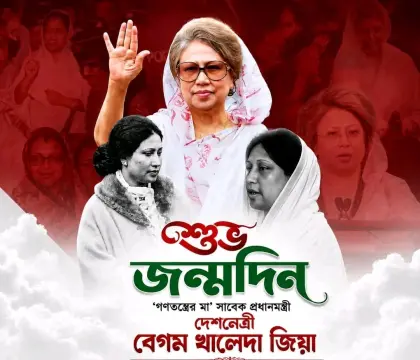
Putting aside her personal grief, she assumed the leadership of the Bangladesh Nationalist Party (BNP). Over time, she emerged as one of the country’s most influential political leaders
Bangladesh’s political landscape has witnessed the rise of many leaders, while many others have gradually faded with the passage of time. Yet there are figures who not only withstand the harsh test of history but become even more prominent as the years pass.
Begum Khaleda Zia is one such political personality. She is not merely a three-time former Prime Minister of Bangladesh; she is one of the principal figures in the country’s long democratic struggle, a symbol of political steadfastness and, for millions of BNP leaders and activists, a central figure of trust and loyalty.
“Uncompromising”—perhaps no single word is more closely associated with her long political career. Personal grief, political adversity, imprisonment, house arrest and various forms of pressure could not persuade her to abandon her political convictions.
From Grief to Political Arena
The assassination of President Ziaur Rahman on May 30, 1981, created a profound vacuum in Bangladesh’s political landscape. At the time, Begum Khaleda Zia was a homemaker with no direct involvement in active politics. Following the tragic death of her husband, however, she was compelled to step into the difficult and demanding arena of national politics.
Putting aside her personal grief, she assumed the leadership of the Bangladesh Nationalist Party (BNP). Over time, she emerged as one of the country’s most influential political leaders. Her political rise was not simply a transition into power politics; it was also the story of taking responsibility for leading a political party and carrying forward an ideological legacy.
Leading the Anti-Autocracy Movement
During the 1980s, Begum Khaleda Zia’s role in the movement against military rule established her as one of the leading figures in national politics.
She remained at the forefront of the mass movement against autocratic rule in the 1990s. Arrest, house arrest and political pressure did not force her to withdraw from the struggle. Eventually, the mass movement of 1990 led to the fall of the Ershad government and opened a new chapter in Bangladesh’s democratic journey.
That experience played a significant role in establishing her as one of the important symbols of democratic politics in Bangladesh.
Winning Power Through the People’s Vote
In the 1991 parliamentary election, Begum Khaleda Zia led the BNP to victory and assumed office as Prime Minister. Under her leadership, Bangladesh entered a new phase with the restoration of the parliamentary system of government.
She returned to power after another decisive BNP victory in the 2001 parliamentary election.
During her governments, various initiatives were undertaken in areas including economic liberalisation, private-sector development, industrialisation and infrastructure. The expansion of the readymade garment industry, development of rural infrastructure, improvement of road connectivity and initiatives to strengthen the power sector during her governments were among the developments that contributed to Bangladesh’s broader economic trajectory.
Advancing Women’s Education
Begum Khaleda Zia’s rise as a woman leader in Bangladeshi politics was itself a significant development. During her governments, various initiatives were also taken to expand women’s education and increase women’s participation in public and political life.
Stipends for girls’ education, the expansion of female education and measures to increase women’s representation in local government contributed to broader social change. These initiatives helped make women’s participation in Bangladesh’s political and social spheres increasingly visible.
'Mother of Democracy'
The most frequently discussed aspect of Begum Khaleda Zia’s political identity is her uncompromising stance.
Her position during the political crisis of 2007 and the period surrounding the “1/11” political transition brought her further into the centre of national debate. In the years that followed, despite prolonged political and legal challenges, imprisonment and various restrictions, she remained committed to her political position and party leadership.
For her supporters, this determination is what established her enduring image as an “Uncompromising Leader.”
Resilient in Adversity
Alongside spending significant periods at the centre of political power, Begum Khaleda Zia also endured some of the most difficult periods in opposition politics. The final decades of her political career were marked by numerous cases, political movements, arrests, imprisonment and intense political confrontation.
Her deteriorating health during her imprisonment became a subject of considerable discussion both at home and abroad. The BNP and her supporters campaigned for her release, medical treatment and political rights for an extended period.
According to her supporters, rather than weakening her political standing, these adversities strengthened the emotional bond and loyalty of grassroots BNP leaders and activists toward her.
Principles Over Power
In assessing Begum Khaleda Zia’s political career, her supporters place particular emphasis on her personal sacrifices, political struggles and loyalty to her party.
They believe she did not view politics merely as a means of acquiring personal wealth or enjoying power, but rather as a responsibility to represent the people. Although she has had intense disagreements with her political opponents, her followers regard her political struggle as an important chapter in the history of democracy in Bangladesh.
At the same time, her long political career, like that of any major political leader, has been accompanied by criticism and controversy. Her periods in government and many of her political decisions have been subject to debate. The historical assessment of a statesperson necessarily includes both achievements and limitations. Nevertheless, her enduring influence despite prolonged political adversity cannot be overlooked.
“Mother of Democracy”
Begum Khaleda Zia’s supporters refer to her as the “Mother of Democracy.” The title reflects their admiration for her role in the anti-autocracy movement as well as subsequent struggles over democratic rights and voting rights.
Her relationship with grassroots leaders and activists has also given her a distinctive place in Bangladesh’s political landscape. Many party leaders and activists have viewed her not merely as their party chief but also as a guardian and family-like figure.
A Long Chapter in History
Despite age, health challenges, imprisonment and prolonged political adversity, Begum Khaleda Zia’s name remains deeply connected to a long and important chapter in Bangladesh’s political history.
She is simultaneously a pioneering woman political leader, a former Prime Minister, the Chairperson of the BNP and one of the principal figures of Bangladesh’s long-running opposition movements. Her political career is rich in achievements, but it is also marked by controversy and political disagreement.
Yet the longevity and depth of her political influence demonstrate the extent to which she has remained an important figure in Bangladesh’s political history.
For the younger generation, perhaps the most important lesson from her political journey is that politics is not simply about acquiring power. It involves responsibility, sacrifice, principles, accountability to the people and the courage to stand by one’s convictions in the face of adversity.
Ultimately, history judges every political figure through a comprehensive assessment of their time, actions, achievements, failures and controversies. Begum Khaleda Zia will be no exception.
One thing, however, is certain: her name will remain associated with a long and significant chapter in the political history of Bangladesh.
She is Begum Khaleda Zia—a woman leader, a former Prime Minister and, to her supporters, a symbol of uncompromising political struggle.
How history will ultimately assess her legacy is a verdict that only time can deliver.
Shamiur Rahman