
- Politics /
- Tarique Rahman Listens More, Speaks Less

Shaheen Abdul Bari
Published:2026-01-12 10:11:18 BdST
Tarique Rahman Listens More, Speaks Less
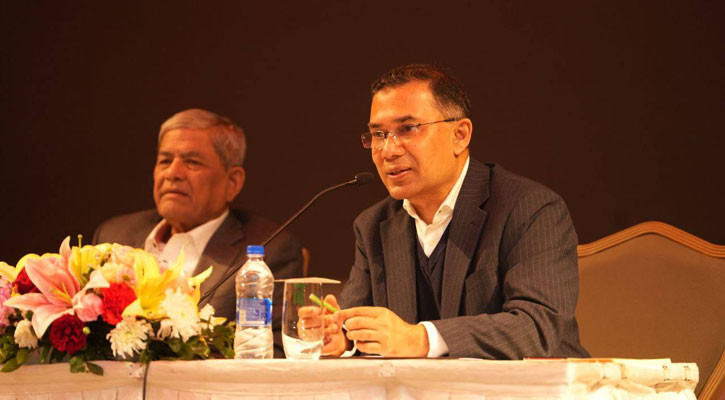
Last Saturday (10 January), at an event held at the Sheraton Hotel in Banani, Dhaka, Tarique Rahman attended his first official program after assuming responsibility as Chairman of the BNP. At the event, he listened attentively to various suggestions and concerns raised by editors of national-level media outlets. Senior journalists also stood up from their seats and spoke into the microphone, conveying greetings and sharing their views on different issues.
Editors of Amar Desh newspaper Mahmudur Rahman, Shafik Rehman, Nurul Kabir, Mahfuz Anam, along with many other eminent editors, took the stage to speak. Although everyone expressed their views in their own way. It was clear that no one spoke without purpose.
During the event, Amar Desh editor Mahmudur Rahman addressed Tarique Rahman, saying:
“You were not in the country for 17 years. You are hearing what the people around you are telling you. But that is not the real history of these 17 years. I will explain that history to you. If there is another program, I will narrate 50 years of history in 15 minutes.” Tarique Rahman took note of this remark.
Mahmudur Rahman further said: “Mr. Tarique Rahman, you were not in the country for 17 years. You do not know what happened here. What distinguished people around you told you—that is what you heard. Now the new friends from the media are telling you things, and you are assuming that this is the history of Bangladesh over the last 17 years. No, this is not the history of 17 years.”
Is what Mahmudur Rahman said correct? It is true that he was beaten, injured, forced to flee, and subjected to oppression during the Awami League government. But to say that Tarique Rahman knows nothing about the country or was unaware of events reflects either ignorance or a calculated strategy to get closer to him—perhaps to secure 15 minutes at a future meeting to subtly defend a particular political party.
Analysts believe that Tarique Rahman, the BNP Chairman, has gained experience far beyond what Mahmudur Rahman has learned.
For Mahmudur Rahman’s information, a portion of Tarique Rahman’s leadership during July–August is outlined below:
In July–August 2024, following Tarique Rahman’s orders and directives, the BNP became fully active after July 13. On July 14, Tarique Rahman held a group meeting with the BNP high command and top leaders of Chhatra Dal and Jubo Dal. He divided Dhaka into 10 zones for organizational work. Four priority zones were Shahbagh, Kakrail, Karwan Bazar, and Dhanmondi. The remaining six zones were formed around Dhaka’s entry points. Each zone was assigned leadership by 10 Chhatra Dal and 10 Jubo Dal members, with several BNP leaders coordinating each zone.
Their main task was to bring Chhatra Dal and Jubo Dal activists from surrounding districts into Dhaka and act as protective shields for students. On the same day, Tarique Rahman instructed Mirza Abbas to arrange food and drinking water for all leaders, activists, and students coming to Dhaka. From July 15 to 18, Mirza Abbas distributed eight truck loaded with water and two truck loaded with packaged food. Later, many more trucks were brought in by Chhatra Dal and Jubo Dal activists.
Those now raising their voices—such as NCP and Shibir—should ask themselves whether they know that students stayed on the streets after eating food arranged by Mirza Abbas.
On July 15, Tarique Rahman held multiple meetings with members of the party high command, instructing district committees to become active and prepare. BNP-aligned transport owners were requested to provide maximum assistance in transporting leaders and activists to Dhaka and within district and upazila towns.
From July 16 onward, district and thana-level BNP units and local Chhatra Dal and Jubo Dal organizations began participating collectively in the movement.
During that time, many district-level administrative officials—primarily Superintendents of Police and Additional Superintendents—were requested to ensure that no bullets were fired at students and that illegal orders were not carried out. In district towns, police operations at the field level generally function under the command of the SP Sadar Circle.
After July 20, control of the nationwide movement collectively shifted to the BNP. During this period, Tarique Rahman personally contacted BNP Secretary General Mirza Fakhrul Islam Alamgir, Mirza Abbas, Dr. Mosharraf Hossain, Salahuddin Ahmed, Habibun Nabi Sohel, Sultan Salahuddin Tuku, as well as many party workers, Facebook activists, YouTubers, and people from various professions. To protect students, London-based Dr. Foyez Uddin MBE and others, on behalf of Tarique Rahman, corresponded with various international offices, including that of then US President Joe Biden. Dr. Foyez Uddin alone sent more than a hundred letters internationally.
In the final week of July, Tarique Rahman held several meetings with BNP-aligned doctors and university teachers, instructing doctors to ensure maximum medical treatment for the injured. Many private clinics, hospitals, and diagnostic centers in Dhaka and districts became involved. BNP-aligned university and college teachers took responsibility for transporting the injured to hospitals.
On the night of August 3, Tarique Rahman held multiple meetings with district-level leaders and instructed them to bring as many people as possible into Dhaka.
From early morning on August 4, hundreds of thousands of BNP and Chhatra Dal activists began gathering in Narayanganj, Chittagong Road, Gazipur, Savar, Dohar, Bikrampur, and other areas.
Separate BNP and Chhatra Dal teams coordinated with private university and madrasa students. Mirza Abbas arranged their accommodation and food in Dhaka. Thousands of BNP activists spent nights in homes across Shahjahanpur, Uttara, Jatrabari, Abdullahpur, and Dohar. Sultan Salahuddin Tuku, Sohel, and Anny risked their lives to carry out Tarique Rahman’s directives.
Communication with student coordinators and Dhaka University students was maintained by Chhatra Dal President Rakib, General Secretary Nasir, and Aman Ullah Aman. Throughout this process, Jamaat or Shibir leaders were not found at the forefront. In some instances, Shibir leaders gave evasive responses, while many individuals disguised as Chhatra League members were seen attacking students and the public.
Former Dhaka Journalists Union General Secretary Mohammad Baker Hossain congratulated Tarique Rahman in a Facebook post, stating that Tarique Rahman fulfilled the expectations associated with being the blood heir of Shaheed President Ziaur Rahman and former Prime Minister Begum Khaleda Zia. By honoring journalists, Tarique Rahman once again proved that the Zia family and BNP are media-friendly. He also thanked Media Cell Chief Dr. Alamgir Pavel and Tarique Rahman’s Information Secretary Saleh Shibli.
Tarique Rahman mentioned the grief of losing his father in 1981 and his mother on December 30, 2025, which deeply moved those present.
The precise objectives of the discussion meeting can best be explained by the organizers. Having multiple objectives is neither unusual nor wrong.
However, it can be reasonably assumed that the main purpose was to exchange journalists’ advice and thoughts to make the party’s election manifesto—ahead of the 13th National Parliamentary Election on February 12—more refined, coordinated, modern, people-oriented, attractive, and acceptable.
The humility, politeness and restraint displayed by Tarique Rahman impressed everyone. When the wife of late journalist A. I. M. Fakhruddin, Momtaz Bilkis, turned back after presenting her book, Tarique Rahman stood up from his chair to receive it—an act that reflected grace and character.
In short, Tarique Rahman listens more and speaks less.
Despite time constraints, in a brief speech, he outlined the essence of his thoughts and plans regarding the economy, unemployment, security, environment, education, health, foreign employment, social security, and women’s development—clearly showing that he had done extensive homework and made productive use of his years in exile.
As stated in the Holy Qur’an: “Allah does not let the reward of those who do good go to waste.” Surely, Tarique Rahman’s efforts will be duly rewarded.
Unauthorized use or reproduction of The Finance Today content for commercial purposes is strictly prohibited.