
- National /
- AL ban turns election into 'authoritarian farce': Hasina

Special Correspondent
Published:2026-01-23 19:45:19 BdST
AL ban turns election into 'authoritarian farce': Hasina
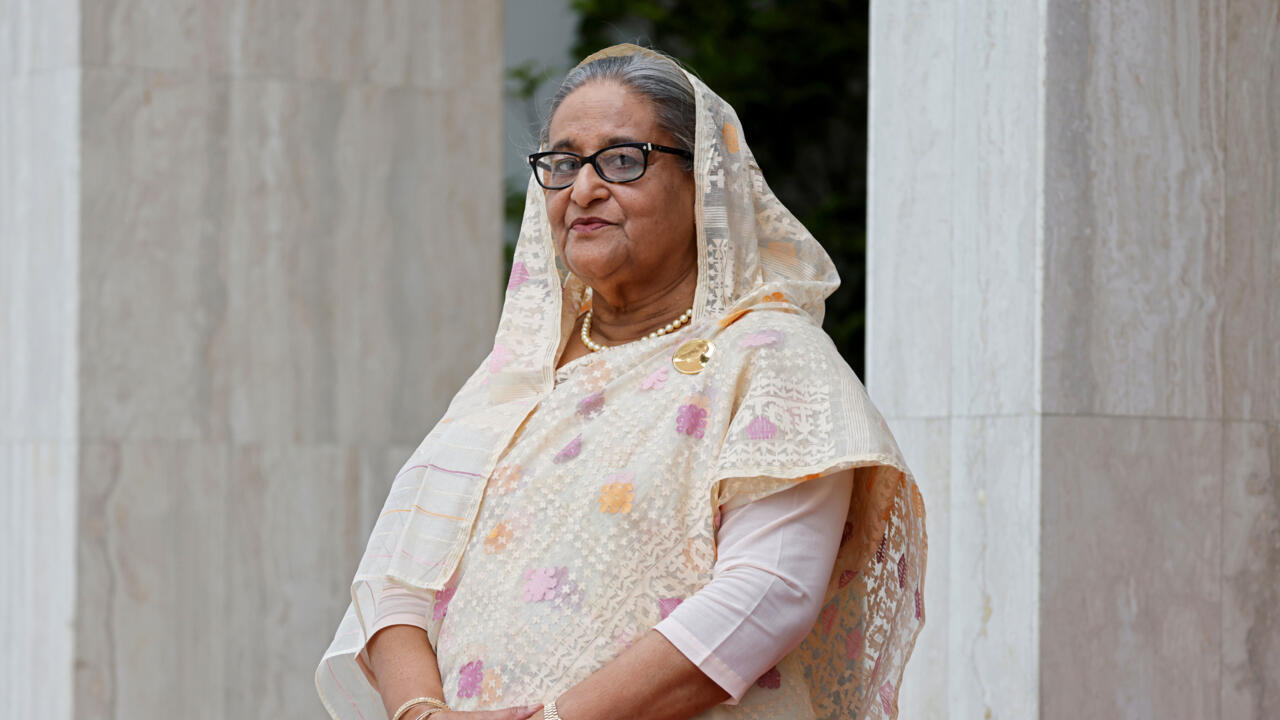
Sheikh Hasina has launched a stinging political broadside against the interim government, accusing Chief Advisor Muhammad Yunus of replacing constitutional rule with what she calls “authoritarianism dressed up as transition” by sidelining her party Awami League ahead of the Feb 12 general elections.
In a wide-ranging written interview with ThePrint, the former prime minister said the suspension of the Awami League from political activity has hollowed out the electoral process, leaving tens of millions of voters effectively “disenfranchised”.
“You cannot ban the country’s oldest and most popular political party and then claim democratic legitimacy. That is not reform; it is authoritarianism dressed up as transition,” Hasina told ThePrint.
Although Yunus has insisted the Awami League has not been banned but merely “suspended from political activities”, Hasina dismissed the distinction as hollow.
“That is a distinction without meaning,” she said, arguing that a party that “can not campaign, organise or contest elections” is, in effect, barred from political life.
‘Free, Fair or Legitimate’
Bangladesh is scheduled to vote on Feb 12, but Hasina said the exclusion of her party has already poisoned the process.
“Elections held under such conditions cannot be considered free, fair or legitimate,” she wrote to ThePrint.
“Voters must be free to elect the party of their choosing and not be excluded from participating or coerced by door-to-door activists into voting for the BNP or [Jamaat-e-Islami] under threats of violence or destruction,” ThePrint quoted her as adding.
She accused the interim government of deliberately clearing the field because it feared defeat.
“The interim government knows that if we were allowed to contest these elections, we would command overwhelming support. That is why we have been banned,” Hasina said.
“Let us not forget that Yunus himself has never received a single vote from the people of Bangladesh, and yet he has rewritten our country’s legal framework to legitimise his unlawful actions,” she was quoted in the report.
The Awami League governed Bangladesh from 2009 until Hasina’s removal in August 2024, shaping nearly a decade and a half of the country’s political life.
Now, as the February vote approaches, Bangladesh is heading into an election without the party that led the 1971 independence struggle and dominated post-independence politics.
2024 Protests and The Fall of Hasina
Violence engulfed Bangladesh in mid-2024, when student-led protests over public sector job quotas spiralled into a nationwide revolt against her government.
According to the interim authorities, roughly 1,400 people were killed as unrest spread across the country.
Hasina told ThePrint she “regrets” every life lost but rejected claims that her government had provoked the bloodshed.
“We welcomed the legitimate protests led by the students and allowed them to proceed peacefully. We listened to their demands, and we addressed these, overturning the public sector job quotas that were the source of their frustration,” she wrote.
She claimed the turning point came when the demonstrations were overtaken by forces working to bring her down.
“What we could not have foreseen was the turning point when extremist elements hijacked the protests. This was no longer a spontaneous and peaceful student movement, but a violent mob organised and directed by Yunus that sought violence, attacked police stations and destroyed state infrastructure,” Hasina told ThePrint.
“Like any legitimate government, our actions were guided by the instinct to protect our country’s institutions and prevent any loss of life,” she added.
On Aug 5, 2024, as violence intensified in Dhaka, Hasina fled her official residence, Ganabhaban, ending her 15 years in power.
She has remained in India since then, a fact that has become a sensitive fault line in India-Bangladesh relations.
‘Dissolved Inquiry’
ThePrint reported that one of Hasina’s sharpest accusations against Yunus centres on the judicial inquiry she had set up to investigate the deaths during the protests -- and which was scrapped almost immediately after the interim government took power.
“My principal frustration is that Yunus dissolved that inquiry immediately upon taking power, no doubt because he knew that it would expose the meticulous plan he orchestrated,” she wrote to ThePrint.
“That decision alone raises serious questions as to the motivations behind the protests and his seizure of power, including the matter of foreign involvement. Those questions deserve impartial investigation.”
Since her removal, the International Crimes Tribunal (ICT) has sentenced Hasina and her home minister Asaduzzaman Khan Kamal to death for crimes against humanity, citing her government’s attempts to suppress the 2024 unrest.
Under Yunus, the Awami League’s organisational backbone has also been dismantled. Its student wing, Bangladesh Chhatra League, was banned under anti-terrorism legislation -- a law originally enacted under Hasina’s government in 2009 and amended in 2025 before being used against her party.
Law and Order Unravelling
Hasina told ThePrint that Bangladesh is now sliding into chaos under an unelected administration that lacks the authority or will to control violence.
“Law and order cannot be maintained through fear or selective enforcement,” she wrote, calling for a swift return to “constitutional governance” and elections “held with the participation of all parties”.
Her warning comes after two days of unrest in December, triggered by the killing of Sharif Osman bin Hadi, a prospective candidate for parliament who was shot in Dhaka on Dec 12 and later died on Dec 18 while under treatment in Singapore.
Protests spiralled into riots that saw the offices of Prothom Alo and The Daily Star set ablaze.
“The violence we are witnessing is the direct result of an unelected administration that lacks any popular mandate and has allowed our politics to be usurped by extremist factions,” Hasina told ThePrint.
“Instead of delivering ‘reform’, the interim government has elevated radical groups to positions of power, established rule by mob justice, and suppressed legitimate political voices,” she was quoted as saying.
“In Bangladesh today, there is no semblance of law and order,” she added.
“The Yunus government has routinely failed to act decisively against violence. Indeed, it has actively emboldened extremists who seek to spread their hardline ideology through daily acts of brutality, repressing any trace of pluralism in our society and dismissing any diversity of thought by labelling any dissenting voice as a political enemy,” she said according to ThePrint.
Minorities and The Rise of Jamaat
The December unrest included the lynching of Dipu Chandra Das, a Hindu man in Mymensingh, sparking protests in India and renewed concern over the safety of Bangladesh’s minorities.
Hindus account for about 8 percent of the population. India has repeatedly urged Dhaka to do more to protect minorities since Hasina’s fall.
Yunus has argued the violence is largely political or criminal rather than communal, saying only 71 of 645 incidents against minorities in 2025 had communal elements, according to ThePrint.
Hasina, however, sees a deeper ideological shift.
“Bangladesh was founded on secularism, pluralism and democratic values. The rehabilitation of Jamaat-e-Islami and other extremist factions threatens the very fabric of our nation,” she wrote to ThePrint.
“When radical groups are allowed back into mainstream politics, they do not moderate the state. They seek to reshape it in their own image and remove any trace of pluralism,” she added.
Jamaat has re-entered mainstream politics since Yunus lifted the ban on its activities, while its student wing Islami Chhatra Shibir has won university elections across several campuses.
History Under Assault
Hasina also accused the interim government of tolerating what she called a systematic attempt to rewrite Bangladesh’s past -- including the vandalism and demolition of her father Sheikh Mujibur Rahman’s historic home at Dhanmondi 32.
“What we are seeing today is the deliberate erosion of historical truth,” she wrote to ThePrint. “Extremist and revisionist forces have tried hard to dilute the reality of our hard-won independence from Pakistan in 1971, blurring the distinction between victim and aggressor.”
“This truth may be inconvenient to the interim government, which wishes to paint the Awami League as enemies of the state, but it is a truth nonetheless,” she added.
“A nation that forgets the price of its freedom becomes vulnerable to those who once denied it. Preserving the truth of our Liberation War is not about politics. It is about safeguarding our identity and sovereignty.”
As Bangladesh moves towards its most uncertain election in decades, February now looms as a reckoning -- not only over who governs, but over what kind of state the country is becoming.
Unauthorized use or reproduction of The Finance Today content for commercial purposes is strictly prohibited.