Gas-Power crisis hits industrial sector; Businesses in peril
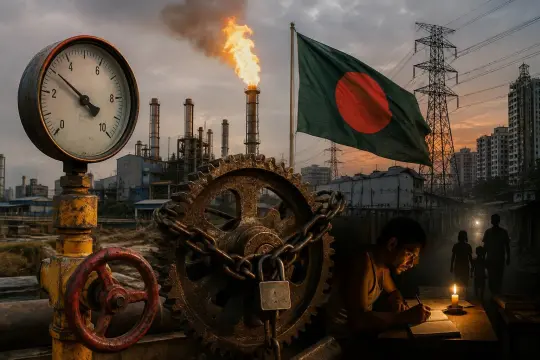
Electricity shortage, alongside the gas crisis, is further disrupting industrial production. With inadequate energy supplies, production costs are rising while businesses are incurring mounting financial losses every day
The country’s industrial sector is facing severe disruption due to an acute shortage of gas and electricity. Inadequate gas pressure and unreliable power supplies have hampered production at factories of all sizes. Despite investments worth hundreds of crores of taka, many industrial units are unable to operate at full capacity. In some cases, production has fallen by half, while in others, factory operations have come to a complete halt.
Industrial entrepreneurs say the prolonged energy crisis is not only disrupting current production but also putting new investment, employment, exports and the overall competitiveness of the industrial sector at serious risk. If the crisis persists, many businesses may struggle to repay bank loans, pay gas and electricity bills, and meet workers’ wage obligations.
Shawkat Aziz Russell, president of the Bangladesh Textile Mills Association (BTMA), said that despite repeated assurances from the government, there has been no significant improvement in gas supply to industrial zones.
As a result, more than half of the country’s textile and yarn-producing mills have reportedly been forced to shut down.
According to Russell, more than 900 textile mills out of over 1,800 BTMA members are currently completely closed. The situation has arisen because gas supplies are less than half of the sector’s demand. Many other factories are operating at half or even lower capacity.
Russell said the electricity shortage, alongside the gas crisis, is further disrupting industrial production. With inadequate energy supplies, production costs are rising while businesses are incurring mounting financial losses every day.
Energy crisis drives up production costs
Industrialists say many factories are being forced to rely on alternative fuels and generators simply to keep operations running. Purchasing diesel and other fuels at high prices has significantly increased production costs, weakening the competitiveness of domestic industries.
Export-oriented industries are particularly vulnerable. Production disruptions are making it increasingly difficult for manufacturers to complete and ship orders on time. This could make it harder for Bangladeshi companies to retain international buyers and remain competitive in the global market.
Russell said industrial entrepreneurs still have to pay bank loan instalments, workers’ wages and other fixed expenses even when they do not receive adequate gas or electricity.
“Factories may have little or no income when production stops, but their expenses continue,” he said, warning that many businesses are now facing an existential crisis.
‘Zero Gas Pressure, Tk 2 Crore Daily Loss’
The managing director of a leading spinning mill in Araihazar, Narayanganj, speaking on condition of anonymity, said gas pressure at his factory had fallen to almost zero.
He said the government had assured industrial users that gas pressure would be maintained at 15 PSI.
But the extremely low pressure has brought production at the factory almost to a standstill, causing financial losses of around Tk 2 crore every day, he said.
“We have no other option left. Eventually, we may have to sell our property to pay workers’ wages,” the entrepreneur said.
He also expressed concern that if the gas crisis continues, most factory owners may find it difficult to pay gas and electricity bills for July and August as well as workers’ wages on time.
‘Deadlines Missed, No Assurances Left’
Minhaj Haque, managing director of Fatullah Dyeing and Calendaring Ltd, said the government had repeatedly assured industrialists that the gas situation would improve.
But several deadlines have passed without any meaningful improvement, leaving businesses uncertain about when the crisis will end.
“The government gave us assurances several times before. But after several deadlines passed, they can no longer offer us any hope. We are completely in the dark about when the situation will return to normal,” he said.
Crisis persists across industrial zones
Entrepreneurs in Narayanganj, Savar, Gazipur, Mymensingh and Manikganj said gas supplies improved slightly in some areas on Friday, but the situation subsequently deteriorated again. In some areas, the situation has become even worse.
Business owners said irregular and low-pressure gas supplies have made it impossible to plan production effectively. While factories continue to bear the costs of workers, utilities and other fixed expenses, declining production is reducing revenues and putting increasing pressure on cash flow.
Workers protest over energy shortages in Madhabdi
Meanwhile, workers in Madhabdi, one of the country’s major textile and weaving hubs in Narsingdi, reportedly took to the streets demanding uninterrupted gas and electricity supplies.
Abdullah Al Mamun, former president of the Narsingdi Chamber of Commerce and Industry, said workers at weaving mills in Narsingdi have lost their incomes as factories remain closed.
He said workers took to the Dhaka-Sylhet highway demanding uninterrupted gas and electricity supplies.
Most workers in the weaving sector are paid based on production, Mamun said. As a result, when factory production stops, their incomes also disappear.
However, Madhabdi Police Station Officer-in-Charge (OC) Kamal Hossain denied receiving any information about such a protest. Attempts to contact Shibpur Police Station OC Md Kohinur Mia for comment were unsuccessful.
August 6 assurance fails to ease concerns
On August 6, Power, Energy and Mineral Resources Minister Iqbal Hasan Mahmud assured business leaders and industrial owners that the gas supply situation would improve quickly.
However, with no significant improvement reported in industrial areas by August 21, entrepreneurs have expressed growing frustration and disappointment.
Industrialists say simply increasing gas supplies temporarily will not provide a sustainable solution. They called for increased domestic gas extraction, intensified exploration for new gas reserves and stronger policy support for alternative energy sources.
Production, jobs and investment all at risk
Industrial entrepreneurs say the gas and electricity crisis is no longer merely a problem of disrupted production. It is increasingly threatening investment, employment and export earnings.
If factories remain closed for an extended period, workers’ incomes will decline, businesses’ ability to repay loans will weaken and investor confidence could deteriorate further.
At the same time, export-oriented manufacturers that fail to deliver products on schedule risk losing the confidence of international buyers.
Entrepreneurs have therefore urged the government to ensure reliable and uninterrupted gas and electricity supplies to protect the industrial sector. They have also called for increased domestic gas production, greater capacity in energy infrastructure and effective policy support for alternative fuels.
The stakes go far beyond individual factories. When the wheels of industrial production stop, workers’ incomes, entrepreneurs’ investments, export opportunities and a vital part of the national economy are all put at risk.
Shamiur Rahman