
- Politics /
- BNP moving forward at a remarkable pace under Khaleda Zia’s leadership

Shaheen Abdul Bari
Published:2025-12-25 18:29:22 BdST
BNP moving forward at a remarkable pace under Khaleda Zia’s leadership
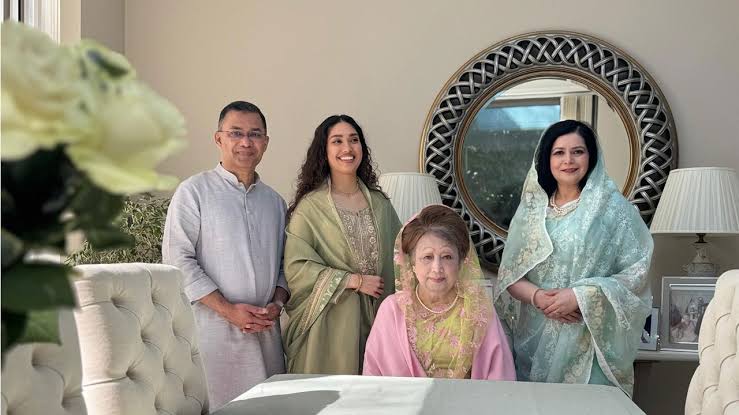
On May 30, 1981, former President Ziaur Rahman was martyred at the Chattogram Circuit House by a misguided group of army personnel. After the death of BNP founder Ziaur Rahman, many political parties and sections of the media predicted that the Bangladesh Nationalist Party (BNP) would not survive.
However, the barely three-year-old party not only survived, but under the firm, fearless, and farsighted leadership of homemaker Begum Khaleda Zia, it moved forward at a remarkable pace. Not only that, after fighting against a powerful autocratic regime, BNP assumed the responsibility of governing the country in 1991 with massive public support.
After the One-Eleven episode, there were renewed conspiracies to marginalize Khaleda Zia and push the party into an existential crisis. Many dismissively commented that the party had no future. But the reality is that the party founded by Shaheed Zia has survived by enduring countless blows, ups and downs, rises and falls, and cycles of destruction and reconstruction. Despite repeated attempts, conspirators failed to suppress BNP.
Political analysts note that this major centrist political party was founded on September 1, 1978, under the leadership of President Ziaur Rahman. After being in state power four times, BNP, following nearly one and a half decades of political darkness, is once again sensing the call of state power and breathing a sigh of relief.
Following the unforgettable student-public uprising that led to the fall and flight of the Sheikh Hasina government, BNP has begun to dream of returning to power. For one and a half decades, everything was stacked against BNP. After One-Eleven, Khaleda Zia, Tarique Rahman, and party leaders and activists were crushed under a military-backed regime. In the rigged 2008 election engineered through a mutual understanding between the Awami League and the Moeen-Fakhruddin group, BNP suffered a crushing defeat.
The state autocratic machinery made all-out efforts to eliminate the party through unspeakable repression and persecution. Through a voterless election in 2013, a night-time vote in 2018, and a dummy election in 2024, BNP was pushed far away from the corridors of power. Party leaders and activists became deeply frustrated and demoralized, with signs of despair even at the top leadership level.
After August 5, 2024, in the new Bangladesh, BNP—like many others—has already gained some relief. Party Chairperson Khaleda Zia has been freed from restrictive conditions. Imprisoned leaders have been released. Repressive cases have been resolved or are being resolved. Fabricated verdicts against Tarique Rahman have been annulled. Restrictions on broadcasting his speeches have been lifted. BNP is receiving its rightful media coverage. Individuals aligned with BNP’s ideology are holding important positions within the administration. Persecuted leaders and activists can now breathe freely, sleep in their homes, and live without constant fear. Millions of nationalist families shattered by legal harassment are experiencing a breath of relief. Meetings and rallies are no longer obstructed.
Despite being out of power for nearly 19 years, BNP and the Zia family remain at the center of the hopes and aspirations of a large section of the population. The timeless nationalist ideology of Shaheed President Ziaur Rahman, along with development-oriented, productive, and democratic politics, remains BNP’s core strength. Some sympathizers, however, express regret that the party has deviated somewhat from this ideology. Concerns have been raised about fears of turning the country into a sanctuary of extremism or sending confusing signals through excessive left-leaning rhetoric. BNP policymakers reject allegations of ideological deviation, but grassroots activists feel disheartened by the rise of “hybrid” opportunists and allegations of favoritism in committee formations.
According to people from various professions, the state of Bangladesh prior to the student-public uprising mirrored the situation nearly five decades earlier, before the August 1975 upheaval—marked by rampant corruption, chaos, instability, frustration, resentment, deprivation, and extreme inequality. Under one-party authoritarian rule, the people were suffocating. Following the establishment of one-party BAKSAL rule on January 25, 1975, multi-party democracy, judicial independence, and press freedom were effectively shut down.
On April 30, 1977, Ziaur Rahman announced a 19-point program and decided to contest the presidential election to implement it. With his patronage, the Nationalist Democratic Party (JAGODAL) was formed, with Vice President Justice Abdus Sattar as its convener. Later that year, the Nationalist Front alliance was established, which announced a 13-point program ahead of the June 3, 1978 presidential election. Ziaur Rahman won that election by a landslide, defeating General Osmani.
After assuming office, Ziaur Rahman founded the Bangladesh Nationalist Party (BNP) on September 1, 1978, through a press conference. JAGODAL and the alliance were dissolved, and the 19-point program became BNP’s guiding ideology. Ziaur Rahman first served as convener and later as chairman. Professor AQM Badruddoza Chowdhury became the first Secretary-General.
Through an open-door policy, Zia welcomed politicians from both right- and left-leaning ideologies to build a broad nationalist platform. Over 45 percent of party members were political newcomers and youth. BNP’s core objectives were economic development, democratic advancement, national unity based on Bangladeshi nationalism, and self-reliance, grounded in four principles: absolute faith in Almighty Allah, nationalism, democracy, and economic and social justice.
At its founding, the nation was deeply divided—politically, ideologically, and even over the Liberation War. BNP’s primary mission was to heal these divisions and unite the nation. Ziaur Rahman reopened political space for parties dissolved under BAKSAL, including the Awami League, a gesture later forgotten as that party sought to politically cripple BNP.
BNP’s journey has been fraught with challenges. Within two years of its formation, Ziaur Rahman was assassinated. Khaleda Zia then assumed leadership, building an uncompromising image through her fight against autocracy, leading to victory in the 1990 mass uprising and democratic transition. BNP governed twice, contributing to national development while repeatedly facing domestic and foreign conspiracies.
Elections ahead differ significantly from past contests. Without the Awami League formally participating, voters now face ideologically similar alternatives. BNP must prove itself the most credible nationalist and Islamic-leaning force. The behavior of Awami League voters, the uncertainty of first-time young voters, and a distorted electoral system pose serious challenges. Nearly half of voters remain undecided, making the upcoming 13th parliamentary election more difficult than any before. BNP Acting Chairman Tarique Rahman has warned that the election will not be as easy as many assume.
Despite favorable conditions, uncertainties persist. Issues around election roadmaps, case resolutions, state reforms, political negotiations, internal tensions, and external conspiracies continue to haunt BNP. As the election approaches, instability grows. For a peaceful election and democratic transition, BNP must demonstrate prudence, foresight, inclusiveness, and political wisdom—otherwise, hard-earned opportunities may be squandered. Breaking the web of domestic and foreign conspiracies through strategic wisdom is now imperative for BNP.
Unauthorized use or reproduction of The Finance Today content for commercial purposes is strictly prohibited.