25 Agencies Face Monopoly Allegations | BAIRA Seeks BOESL One-Stop Service
Malaysia Labour Market Under Fresh Syndicate Shadow
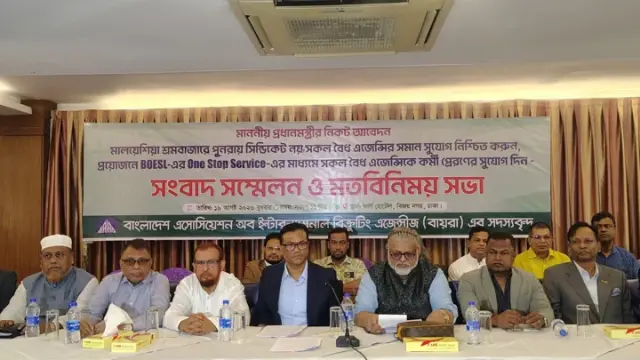
BAIRA members made the demands at a press conference held at Fars Hotel in the capital on Wednesday (August 19).
As discussions to reopen Malaysia’s labour market for Bangladeshi workers gain momentum, a fresh controversy has emerged over who will control the recruitment process. A group of members of the Bangladesh Association of International Recruiting Agencies (BAIRA) has alleged that efforts are underway to create another “syndicate” centred around just 25 recruiting agencies.
To prevent a possible syndicate from taking control of the market, they have called for Malaysia’s labour market to remain open to all legally authorised and qualified recruiting agencies.
They have also proposed introducing a “one-stop service” through Bangladesh Overseas Employment and Services Limited (BOESL), the government-owned manpower recruitment agency.
BAIRA members made the demands at a press conference held at Fars Hotel in the capital on Wednesday (August 19).
Fakhrul Islam, a former joint secretary general of BAIRA, said they had long been demanding an open and competitive Malaysian labour market for all legitimate recruiting agencies.
However, he claimed that reports from various quarters and media outlets suggested that attempts were again being made to establish a recruitment system controlled by only 25 agencies.
He further alleged that applicants seeking inclusion on the proposed list were being asked to pay as much as RM5 million, equivalent to around Tk170 million, while there were also allegations of plans to collect up to RM5,000 per worker as a “syndicate fee.”
49 Licence Cancellations Raise Questions
Recent government action has intensified concerns surrounding Bangladesh’s recruitment process for Malaysia.
In July, the Ministry of Expatriates’ Welfare and Overseas Employment cancelled the licences of 49 recruiting agencies over allegations of irregularities and syndicate activities in sending workers to Malaysia.
According to the ministry’s notification, the licences were cancelled after courts accepted charge sheets in various criminal cases against the agencies. The allegations included excessive recruitment fees, syndicate formation and irregularities in the recruitment and deployment of workers.
Between 2022 and 2024, nearly 500,000 Bangladeshis were sent to Malaysia. During that period, allegations emerged that workers were charged between Tk400,000 and Tk600,000 each. Amid growing concerns over excessive migration costs and irregularities in the recruitment process, Malaysia closed its labour market to Bangladeshi workers from June 1, 2024.
A report related to an investigation by the Anti-Corruption Commission (ACC) also raised serious concerns. According to the report, agencies under scrutiny allegedly sent 267,276 workers to Malaysia and collected an additional Tk45.45 billion beyond the government-prescribed migration cost.
The figure places the alleged financial irregularities at the level of tens of billions of taka.
Against this backdrop, BAIRA members fear that allowing another limited group of agencies to dominate the market following the cancellation of 49 licences could lead to a repetition of past controversies.
The Syndicate Model Returns?
Fakhrul Islam questioned whether individuals or groups previously accused of involvement in the Malaysian labour-market syndicate could once again be attempting to control the market through a new structure.
If 49 agencies have had their licences cancelled over allegations of syndication, irregularities and corruption, he asked, why should a new system centred on a limited number of agencies be created?
According to allegations cited in the media, substantial sums of money were previously demanded for access to the syndicate, along with large fees from workers. If the current allegations of Tk170 million for inclusion and RM5,000 per worker are found to be true, he said, the situation could signal an even more serious form of market control.
Analysts say the allegations should be independently investigated to establish their authenticity.
Malaysia’s Strategic Importance
Malaysia is one of the major destinations for Bangladeshi migrant workers. The closure of its labour market has affected thousands of workers as well as prospective migrants who had hoped to secure employment there.
Malaysia recognises Bangladesh as one of its approved labour-source countries. The country has a government-regulated system for recruiting foreign workers, including employer quotas and approvals, with foreign workers employed in sectors such as manufacturing, construction, agriculture, plantation and selected services.
Therefore, recruitment from Bangladesh does not depend solely on Bangladeshi recruiting agencies. Malaysian employers, quota allocations and government approval procedures are also critical components of the process.
For this reason, any new recruitment framework must clearly disclose who will select workers, who will collect employers’ demands and how recruiting agencies will be approved.
BAIRA’s Five Key Demands
BAIRA members presented five major demands at the press conference.
First, equal opportunities for all legitimate agencies. They called for all legally authorised and qualified Bangladeshi recruiting agencies to be allowed to send workers to Malaysia, similar to recruitment arrangements involving other labour-source countries such as Nepal.
Second, an end to discriminatory agency selection. Instead of placing the entire market in the hands of 25, 50 or 100 agencies, any selection process should be based on transparent, objective and neutral criteria.
Third, revision of controversial provisions in the memorandum of understanding. They proposed that the selection of Bangladeshi recruiting agencies should not depend solely on a decision by the Malaysian authorities, but should involve the Bangladesh government or relevant employers through a transparent mechanism.
Fourth, introduction of a one-stop service through BOESL. If Malaysia prefers to recruit through a limited number of approved channels, BAIRA members proposed strengthening BOESL and establishing a centralised system through which all qualified agencies could participate.
Fifth, lower migration costs. They called for a transparent worker database through the Bureau of Manpower, Employment and Training (BMET), collection of government-approved migration costs in instalments through the Probashi Kallyan Bank, and stronger government monitoring.
Can the BOESL Model Work?
BOESL operates under government management to recruit and deploy workers to different countries. Its digital systems provide applicants with access to job applications and updates on the progress of their applications. In 2026, BOESL also conducted recruitment activities for positions in Malaysia, including housekeeping attendants and spa therapists.
A BOESL-based one-stop service could potentially create a centralised digital platform covering employer demands, worker databases, agency participation, government approvals, fees and BMET clearance.
Such a system could also make it easier to track each stage of the recruitment process and identify irregularities.
However, the effectiveness of such a model would depend heavily on BOESL’s institutional capacity, manpower, technological infrastructure and coordination with the Malaysian government.
Malaysia’s Centralised Oversight
Malaysia itself maintains centralised mechanisms for the recruitment of foreign workers. Its Ministry of Home Affairs operates a one-stop centre that handles foreign-worker quota applications, levy payments, inspections and related administrative procedures.
Meanwhile, Malaysia’s Human Resources Ministry said in April 2026 that no final decision had yet been made on a new centralised digital system for foreign-worker recruitment and that proposals were still being evaluated with relevant stakeholders. The ministry also expressed concerns about weaknesses in recruitment processes in source countries and the risks of worker indebtedness and exploitation.
This demonstrates that simply limiting the number of recruiting agencies does not necessarily eliminate syndicates. Transparency at every stage of recruitment, traceability of financial transactions and accountability are far more important.
Workers Bear the Cost
Migrant workers are likely to suffer the greatest consequences if syndicates emerge.
An increase in intermediaries can drive up migration costs, forcing workers to borrow money to finance their journey. The Malaysian recruitment controversy of previous years was also closely associated with allegations of excessive migration expenses.
Between 2022 and 2024, workers were reportedly charged several hundred thousand taka each. After Malaysia closed its labour market, numerous cases also emerged involving workers whose money had become stuck in the recruitment process.
Therefore, before reopening the market, the government must give priority to three fundamental questions: How much will workers be charged, who will collect the money, and where will the money be deposited?
Failure to address these questions could allow the problems of the past to return.
Transparency for a Fair Labour Market
Malaysia remains a crucial destination for Bangladeshi workers. At the same time, reopening the market represents a major test of whether Bangladesh has learned from the controversies of the past.
Following the cancellation of 49 agencies’ licences, the priority should be to establish a transparent, competitive and technology-driven recruitment system rather than allowing another group to dominate the market.
The government could introduce mandatory verification of each recruiting agency’s eligibility, publication of employer demands, transparent worker-selection criteria, disclosure of government-approved fees, banking-channel transactions and digital tracking for every worker.
Bangladesh’s government recruitment-agent information system already provides information on licensed agencies, including licence numbers, status and validity. Strengthening this database and establishing a dedicated real-time public dashboard for the Malaysian labour market could provide greater public oversight.
Such a dashboard could disclose how many workers each agency is processing, how much workers are being charged and what stage of the recruitment process each worker has reached.
The Government’s Crucial Test
The most important question surrounding the reopening of Malaysia’s labour market is therefore not simply how many workers will be sent.
The real questions are: Who will send them? How will they be selected? And how much will workers have to pay?
If the market is concentrated in the hands of 25 agencies, allegations of a new syndicate could emerge. On the other hand, allowing hundreds of agencies to operate without clear standards could weaken oversight.
A possible solution lies somewhere between the two extremes: open competition based on merit, centralised government oversight and fully digital recruitment and financial management.
The BOESL one-stop service proposed by BAIRA members could provide a potential framework for such a model. But simply launching a new service will not be enough. It would require clear and publicly disclosed rules, impartial agency selection, employer verification, fee ceilings, banking-channel transactions and an effective mechanism for investigating complaints.
The real test for Malaysia’s labour market this time will therefore be whether Bangladesh can genuinely build a transparent recruitment system—or whether the old syndicate will simply return under a new name.
Shamiur Rahman